

Microwave Doppler Radar Motion Detector Sensor RCWL-0516 Module Board
Microwave Doppler Radar Motion Detector Sensor RCWL-0516 Module Board
Couldn't load pickup availability
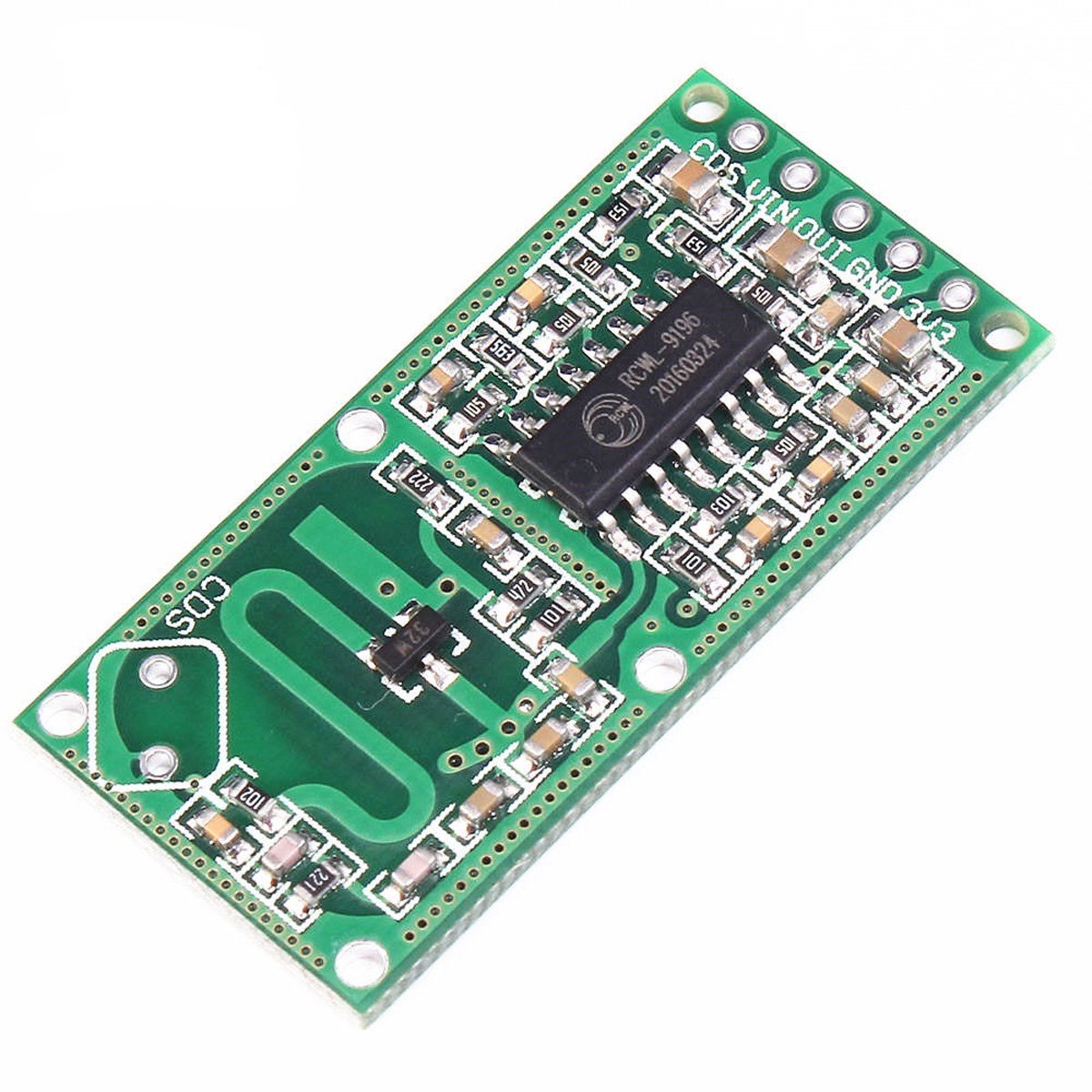
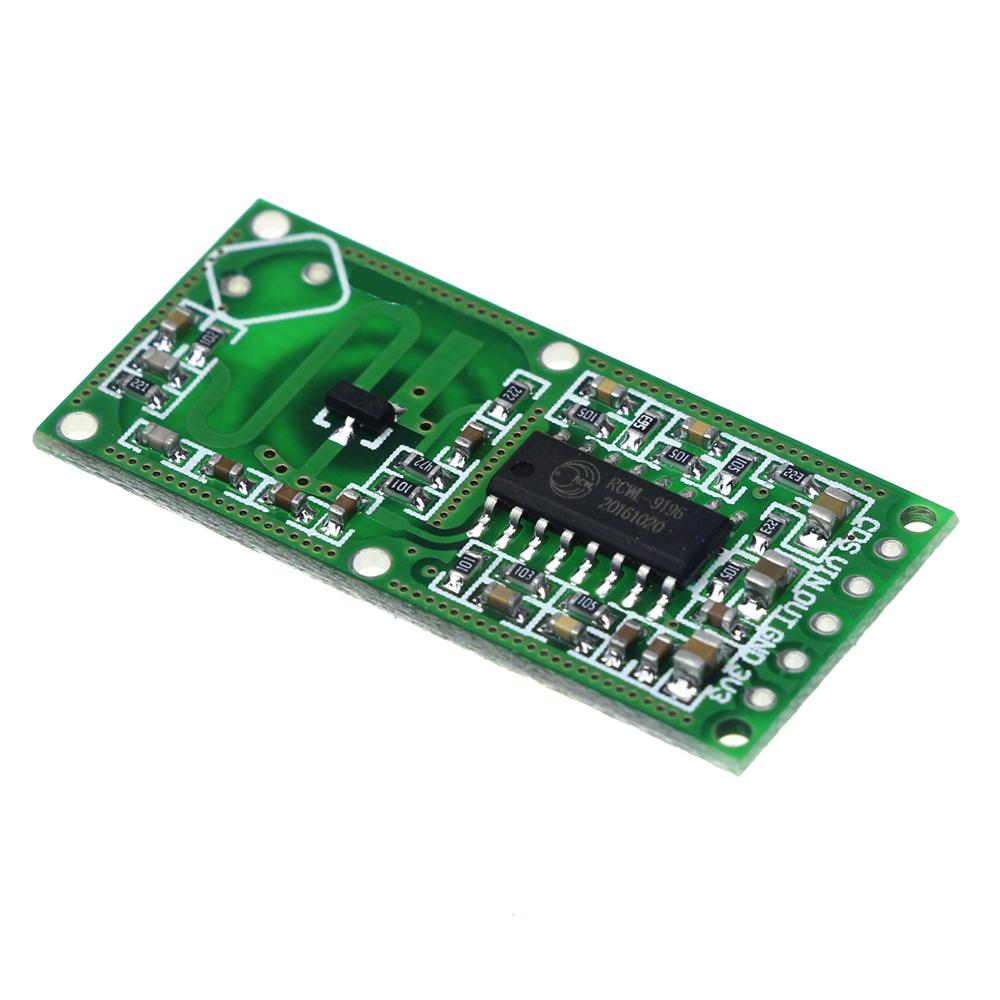
The RCWL-0516 Microwave Doppler Radar Sensor Module is a motion detector that uses microwave radar instead of infrared to sense movement. Unlike PIR sensors that only detect warm-bodied objects, the RCWL-0516 detects motion from any moving object — people, animals, and even non-living things — by measuring changes in reflected microwave signals at approximately 3.18 GHz.
Because microwaves pass through walls, glass, wood, and plastic, this sensor can be mounted inside an enclosure or behind a panel and still detect motion — something a PIR sensor cannot do. It outputs a simple digital HIGH/LOW signal, making it a drop-in alternative to the HC-SR501 PIR sensor in many projects.
⭐ Key Features & Benefits
- Microwave Doppler radar detection — Detects motion from any moving object, not just warm bodies
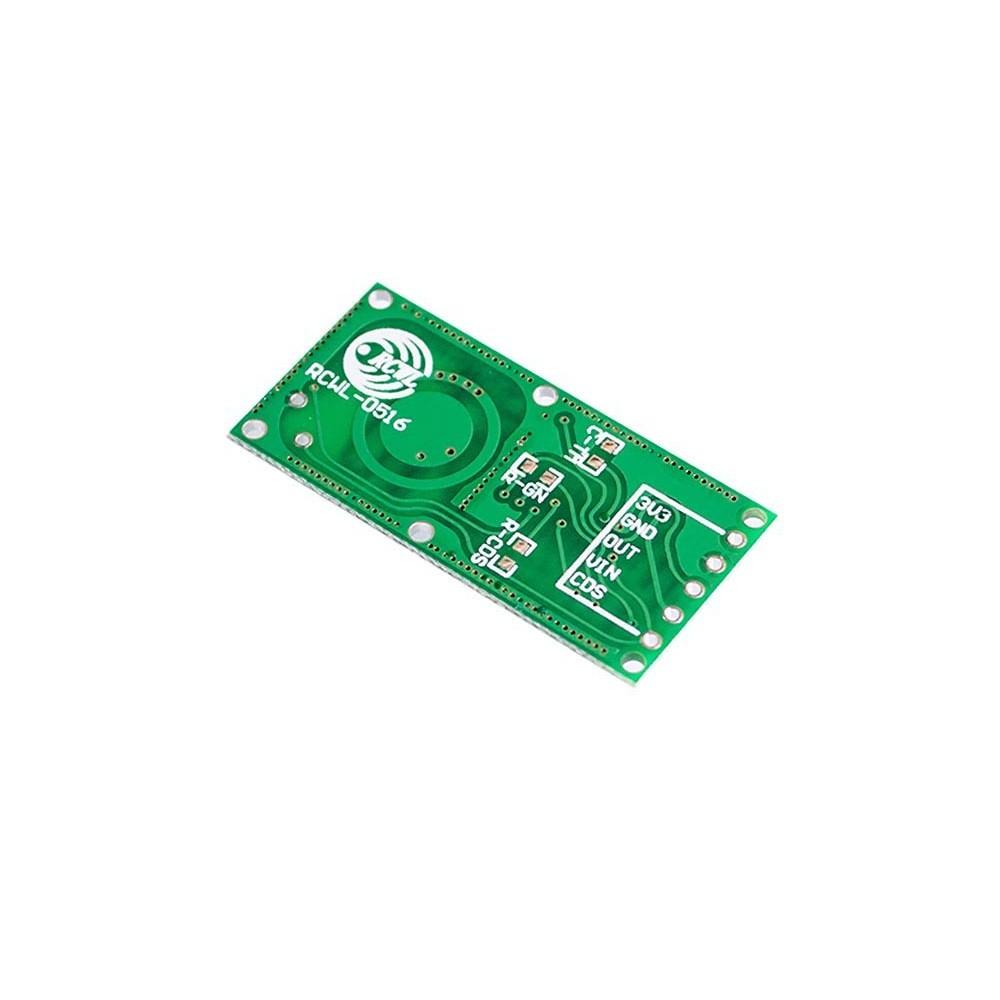
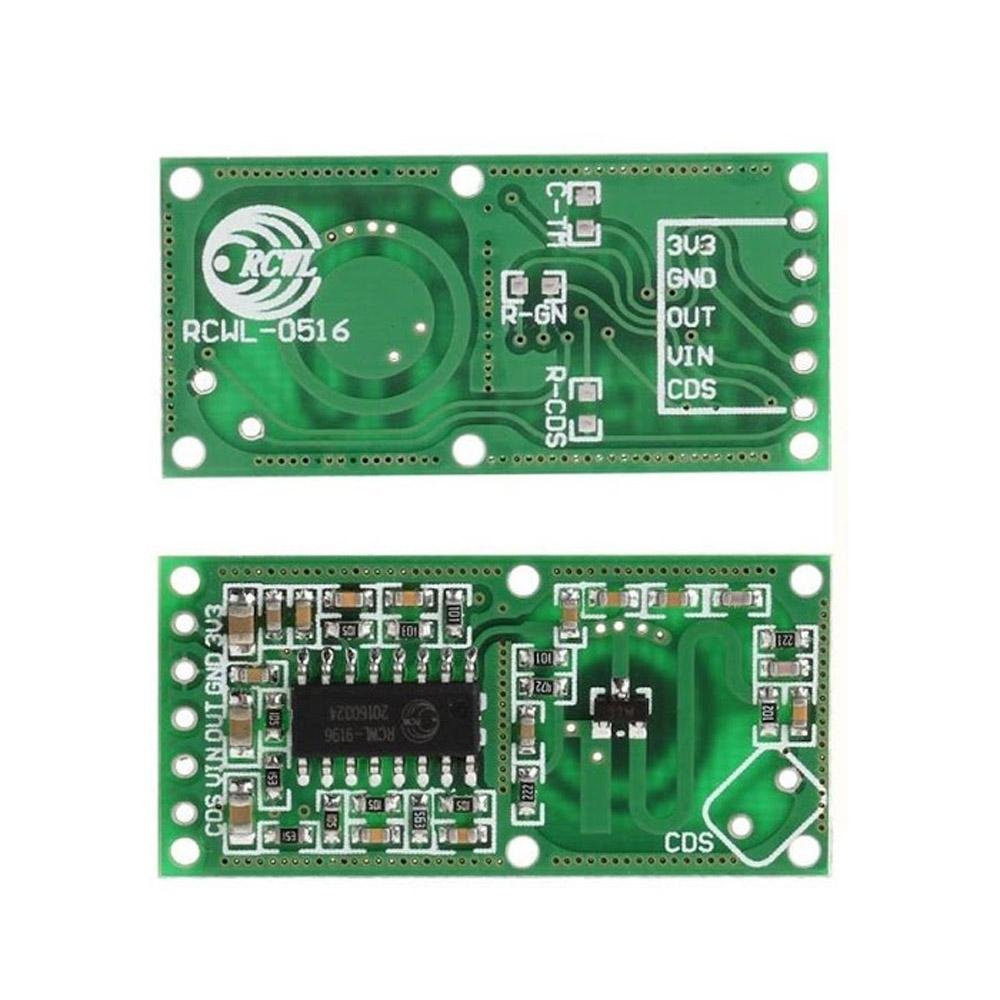
- ~7 meter detection range — Adjustable down to ~1–2m by soldering a resistor on the R-GN pad
- 360° detection pattern — Senses through the board from both sides (component side is more sensitive)
- Penetrates obstacles — Works through walls, glass, thin wood, drywall, and plastic enclosures
- Simple digital output — OUT pin goes HIGH (3.3V) when motion is detected, LOW when idle
- Adjustable trigger hold time — Default ~2 seconds; extend up to ~60 seconds by adding a capacitor to the C-TM pad
- Daylight inhibit feature — Optional LDR connection (CDS pad or CDS pin) disables detection in bright light
- Wide operating voltage — 4V to 28V input with onboard 3.3V regulator
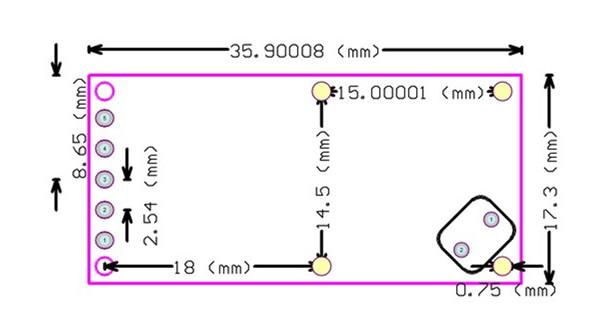
- Ultra-compact — Only ~17mm × 36mm; much smaller than a PIR module
- Low power consumption — Approximately 2.8mA at 5V
📊 Specifications
| Sensor IC | RCWL-9196 |
| Detection Method | Microwave Doppler radar (~3.18 GHz) |
| Detection Range | ~7 meters (adjustable down via R-GN pad) |
| Detection Angle | ~360° (both sides of board) |
| Operating Voltage | 4V – 28V DC |
| Regulated Output | 3.3V (from onboard regulator, ~100mA max) |
| Output Signal | 3.3V HIGH (motion) / 0V LOW (idle) |
| Trigger Hold Time | ~2 seconds default (adjustable via C-TM pad) |
| Trigger Mode | Repeat trigger (output stays HIGH while motion continues) |
| Current Consumption | ~2.8mA at 5V |
| Board Dimensions | ~17.3mm × 35.9mm |
📦 What's in the Box
- 1× RCWL-0516 Microwave Doppler Radar Sensor Module
- Header pins that can be soldered onto the board
📝 Note: Arduino, jumper wires, LDR, and USB cable are not included and must be purchased separately.
🔌 Compatible With
- Arduino Uno / Nano / Mega / Leonardo / Due
- ESP32 / ESP8266 (3.3V compatible)
- Raspberry Pi (GPIO reads 3.3V output directly)
- STM32 and other 3.3V / 5V microcontrollers
- Any system that can read a 3.3V digital signal
🎯 Common Applications
- Motion-activated lighting — Automatic lights that turn on when someone enters a room
- Security and alarm systems — Intrusion detection for homes and offices
- Occupancy detection — Detect whether a room is occupied for HVAC or energy management
- Hidden sensor installations — Mount behind walls, inside enclosures, or under countertops
- Smart home automation — Trigger IoT events using ESP32/ESP8266
- Automatic doors and gates — Trigger door openers when someone approaches
- Interactive displays and exhibits — Activate displays when visitors approach
- Robotics — Obstacle and proximity detection for mobile robots
🚀 Getting Started
Setting up the RCWL-0516 is straightforward — only 3 wires are needed:
- Connect VIN to 5V (accepts 4V–28V), GND to GND, and OUT to any digital pin on your Arduino
- Upload a simple sketch that reads the OUT pin with
digitalRead() - Allow 3 seconds for the sensor to stabilize after power-up
- Walk in front of the sensor — the OUT pin goes HIGH (3.3V) when motion is detected
💡 Tip: See our complete User Guide tab for detailed wiring diagrams, onboard configuration pad reference (sensitivity, trigger time, daylight inhibit), three sample Arduino sketches, a side-by-side comparison with the HC-SR501 PIR sensor, and troubleshooting tips.
🛒 You May Also Need
- HC-SR501 PIR Motion Sensor Module
- Arduino Uno / Nano Development Boards
- Relay Modules (5V)
- Breadboard & Jumper Wire Kits
- Photoresistors / LDRs
📄 Documentation & Resources
- User Guide — Doppler Radar Explained, Wiring, Configuration Pads, Arduino Code, PIR Comparison & Troubleshooting
- All Sensor, Detector & Input Module Guides
Sold and supported by Envistia Mall. Ships from the USA. For wiring diagrams, sample code, and troubleshooting, see the User Guide tab on this product page. The manufacturer and Envistia LLC (dba Envistia Mall) are not responsible for any damages or losses resulting from the use of this product. Always follow proper electrical safety practices when working with electronic components. Specifications are based on manufacturer data and are subject to change without notice.
Share
