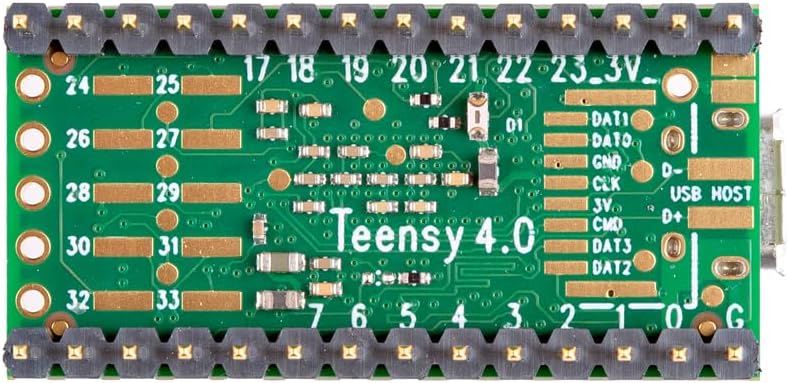
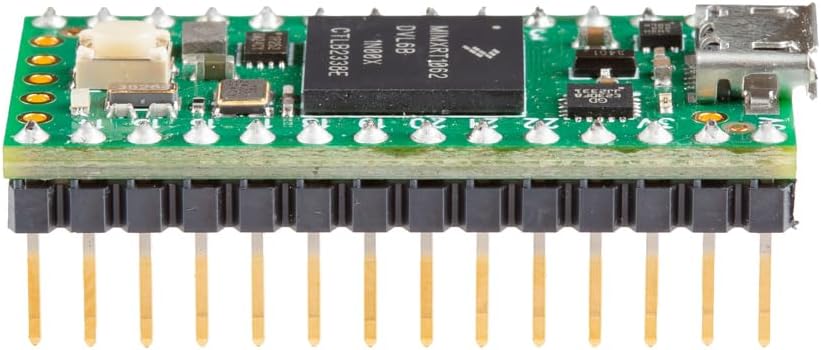
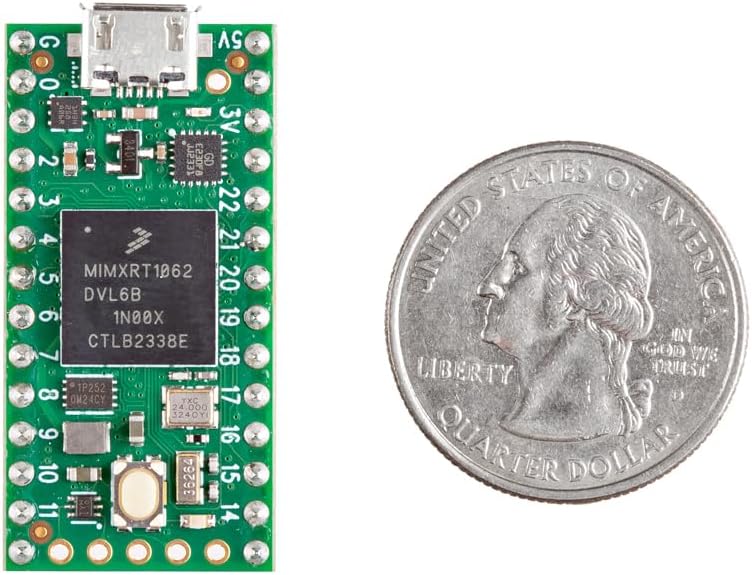
Placa de desarrollo de microcontrolador PJRC Teensy 4.0 iMXRT1062
No se pudo cargar la disponibilidad de retiro
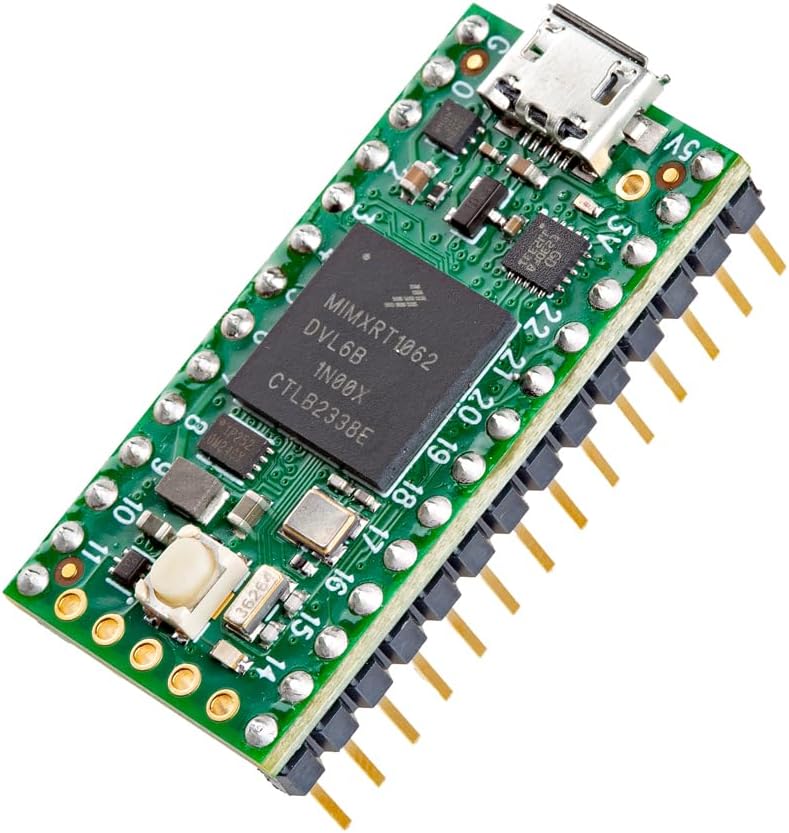
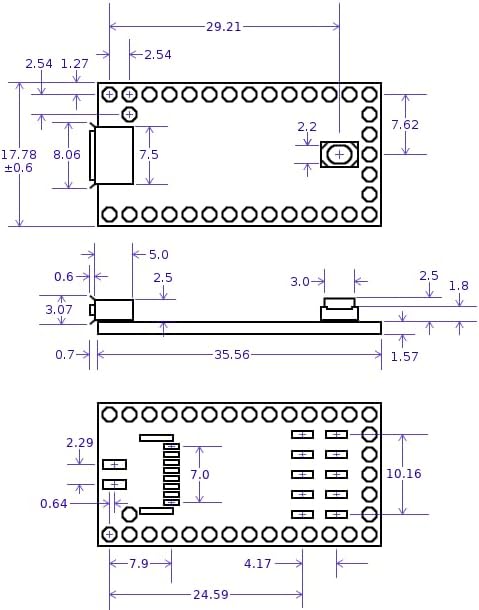
Teensy 4.0 es la última placa de desarrollo de microcontrolador Teensy de PJRC, que ofrece el microcontrolador más rápido y periféricos potentes en el factor de forma Teensy de 1,4 x 0,7 pulgadas (3,6 x 1,8 cm). Cuenta con un procesador ARM Cortex-M7 a 600 MHz, con un chip NXP iMXRT1062, el microcontrolador más rápido disponible en la actualidad. Teensy 4.0 tiene el mismo tamaño y forma que Teensy 3.2 y conserva la compatibilidad con la mayoría de sus funciones de clavija.

El NXP iMXRT1062 es un procesador "cruzado", que tiene la funcionalidad de un microcontrolador a la velocidad de una microcomputadora. Es perfecto para cuando necesita mucho flash, RAM, procesar muchos datos o cuando necesita dos puertos USB de alta velocidad. ¡Incluso tiene un procesador de gráficos integrado!
Teensy 4.0 proporciona soporte para escalado de reloj dinámico. A diferencia de los microcontroladores tradicionales, donde cambiar la velocidad del reloj provoca velocidades de transmisión incorrectas y otros problemas, el hardware de Teensy 4.0 y el soporte de software de Teensyduino para las funciones de temporización de Arduino están diseñados para permitir cambios de velocidad dinámicos. Las velocidades de transmisión en serie, las frecuencias de muestreo de transmisión de audio y las funciones de Arduino como delay() y millis(), y las extensiones de Teensyduino como IntervalTimer y elapsedMillis, continúan funcionando correctamente mientras la CPU cambia de velocidad.
Teensy 4.0 también proporciona una función de apagado. Al conectar un botón al pin de encendido/apagado, la fuente de alimentación de 3,3 V se puede desactivar por completo manteniendo presionado el botón durante 5 segundos y volver a encenderla presionando brevemente el botón. Si una celda tipo botón está conectada a VBAT, el RTC de Teensy 4.0 también continúa realizando un seguimiento de la fecha y la hora mientras está apagado.
El ARM Cortex-M7 trae muchas funciones de CPU potentes a una verdadera plataforma de microcontrolador en tiempo real. Cortex-M7 es un procesador superescalador de doble problema, lo que significa que el M7 puede ejecutar dos instrucciones por ciclo de reloj, a 600 MHz (¡Teensy 4.0 se puede overclockear mucho más allá de 600 MHz)! Cortex-M7 es el primer microcontrolador ARM que utiliza la predicción de bifurcaciones. En M4, los bucles y otros códigos que deben bifurcarse toman tres ciclos de reloj. Con M7, después de que un bucle se haya ejecutado varias veces, la predicción de bifurcación elimina esa sobrecarga, lo que permite que la instrucción de bifurcación se ejecute en un solo ciclo de reloj.
La memoria estrechamente acoplada es una función especial que permite a Cortex-M7 un rápido acceso de ciclo único a la memoria mediante un par de buses de 64 bits de ancho. El bus ITCM proporciona una ruta de 64 bits para obtener instrucciones. El bus DTCM es en realidad un par de rutas de 32 bits, lo que permite que M7 realice hasta 2 accesos de memoria separados en el mismo ciclo. Estos buses de velocidad extremadamente alta están separados del bus AXI principal de M7, que accede a otra memoria y periféricos. Se puede acceder a 512 K de memoria como memoria estrechamente acoplada. Teensyduino asigna automáticamente su código de croquis de Arduino en ITCM y todo el uso de memoria no malloc para el DTCM rápido, a menos que agregue palabras clave adicionales para anular el valor predeterminado optimizado.
La memoria a la que no se accede en los buses estrechamente acoplados está optimizada para DMA acceso por periféricos. Debido a que la mayor parte del acceso a la memoria de M7 se realiza en los 2 buses estrechamente acoplados, los potentes periféricos basados en DMA tienen un excelente acceso a la memoria que no es TCM para una E/S altamente eficiente.
El procesador Cortex-M7 de Teensy 4.0 incluye una unidad de punto flotante (FPU) que admite "doble" de 64 bits y "flotante" de 32 bits. Con la FPU de M4 en Teensy 3.5 y 3.6, y también los chips Atmel SAMD51, solo el flotante de 32 bits se acelera por hardware. Cualquier uso de funciones dobles, dobles como log(), sin(), cos() significa que el software implementado es lento. Teensy 4.0 ejecuta todo esto con hardware FPU.
El Teensy 4.0 está disponible en la versión desbloqueada estándar y en una versión bloqueable adecuada para productos comerciales y aplicaciones seguras para proteger el código de su programa del acceso y copia no autorizados. Haz clic aquí para ver los detalles de Code Security for Lockable Teensy.
Especificaciones técnicas:
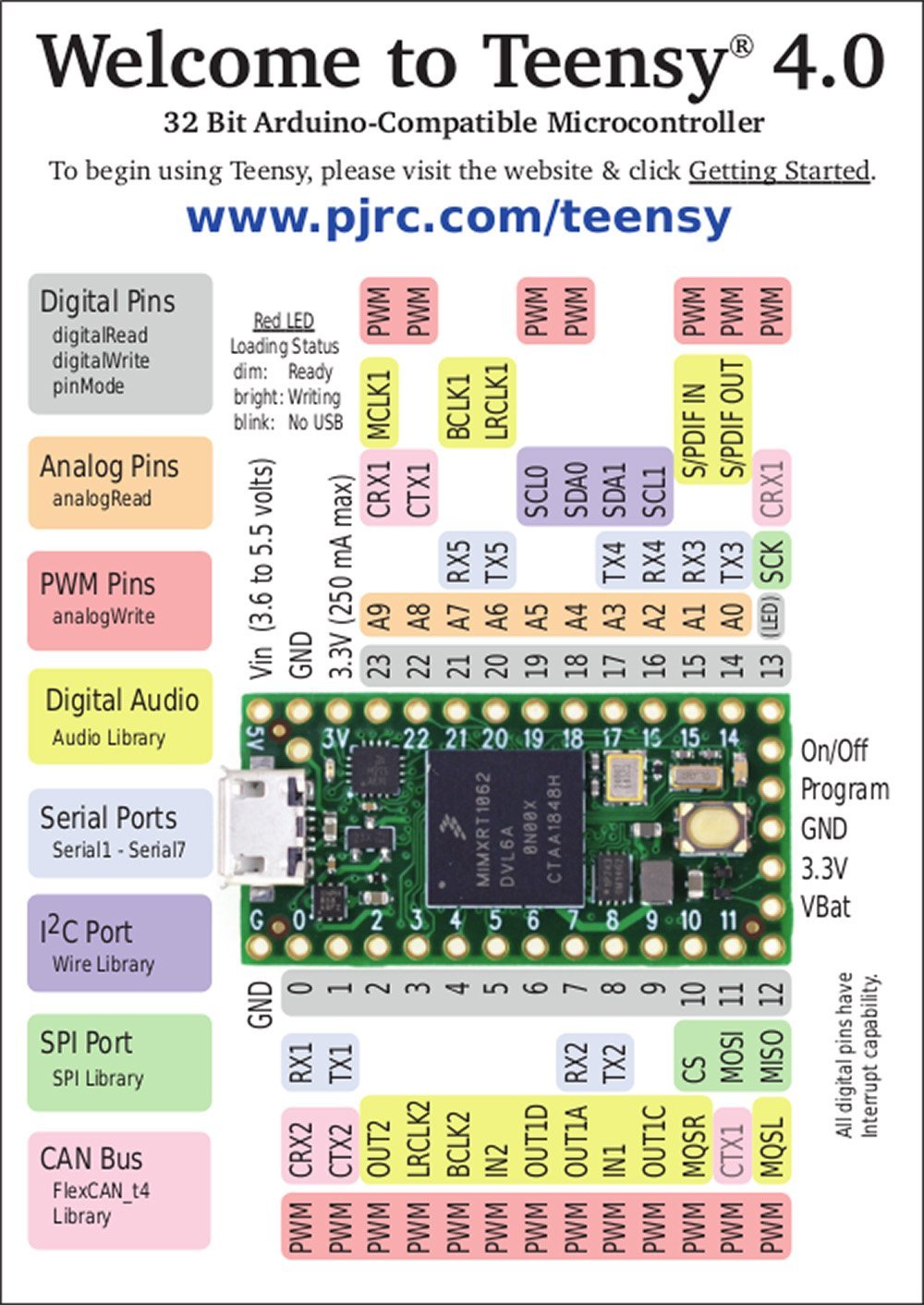
- ARM Cortex-M7 a 600 MHz
- 1024K RAM (512K está estrechamente acoplado)
- 2048K Flash (64K reservados para recuperación y emulación de EEPROM)
- 2 puertos USB, ambos de 480 MBit/seg
- 3 CAN Bus (1 con CAN FD)
- 2 audios digitales I2S
- 1 audio digital S/PDIF
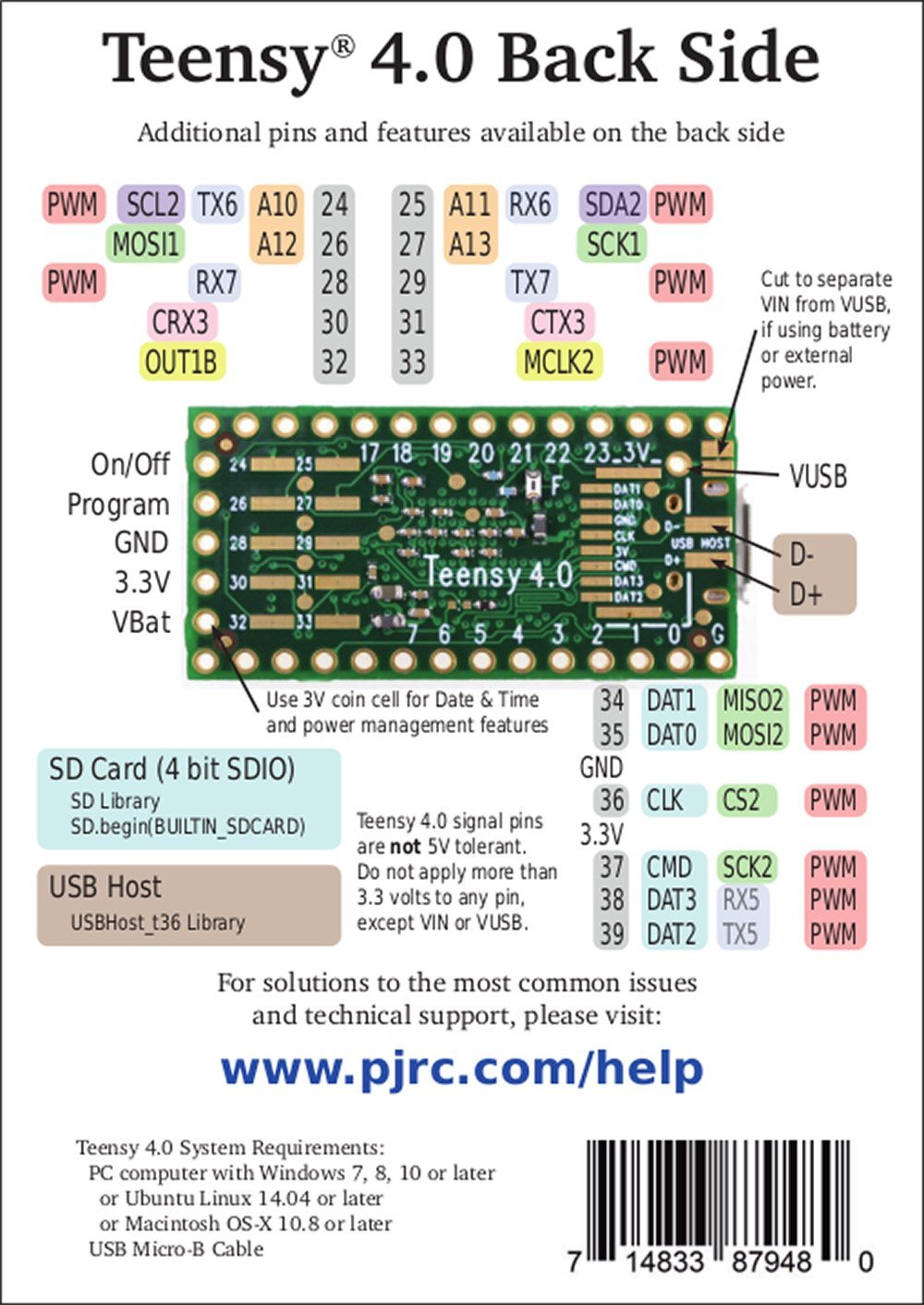
- 1 SDIO (4 bits) SD nativa
- 3 SPI, todos con FIFO de 16 palabras
- 3 I2C, todos con FIFO de 4 bytes
- 7 serie, todos con FIFO de 4 bytes
- 32 canales DMA de propósito general
- 31 pines PWM
- 40 pines digitales, todos con capacidad de interrupción
- 14 pines analógicos, 2 ADC en chip
- Aceleración criptográfica
- Generador de números aleatorios
- RTC para fecha/hora
- FlexIO programable
- Canalización de procesamiento de píxeles
- Activación cruzada periférica
- Gestión de encendido/apagado
Nota: El Teensy 40 no incluye encabezados y, si su aplicación lo necesita, deberá comprarlo por separado y soldarlo usted mismo.< /p>
Recursos:
Protección de adaptador de audio para Teensy 4.0 Rev D
Foro de PJRC para usuarios de Teensy
Página del producto Teensy 4.0 de PJRC
.Share

MMMMMMM Teensy :-)Sometimes a truly god-tier bit of tech comes out and I completely miss the memo. I think that's what happened here. If I may digress: Long ago, I was using serial port connected ADC chips on PC to do DIY electronics prototyping. I believe I was using Radio Skypipe back then if memory serves. Then eventually I discovered Arduino and was using that, again on PC to do live graphing of signals for projects. Then came the legendary Raspberry Pi and for the first time ever, was doing graphing on a dedicated computer. At first, it was the very overused MCP3008 ADC, then the MCP3304 which had 4x the resolution for the same sampling speed. All great! Limited to a mere <= 250ksps but great anyway.And then one day, very recently, I asked MS Copilot about options for higher sampling rate option. And Teensy was mentioned with great praise and numbers I had a hard time believing in. Just connect it to PC or Pi and have IT do the sampling, for up to and beyond 250ksps! What?? Ten times the speed?? BS, surely. I already had one for an upcoming audio project but I shelfed that project in favor of testing and holding MS Copilot to its once again wild claims of grandeur. Imagine my surprise when it turned out to be right! At first I had some problems, mainly with read noise, but I settled on a quick USB serial communication solution with 12 bit depth and 4x averaging at max possible speed for that approach, and easily got my 250ksps for a vastly superior result in data acquisition. The Teensy does the job of capture and serial broadcast, then a Python script receives that and sends it on to Python live plotting solutions over the LAN. Thus I can send the data to a local live grapher on Pi or PC, used for a slower 25 hour long term plot, and also simultaneously send the same data to any other machine on the network, which I use for realtime observation. These graphing programs run typically between 16 and 25 FPS due to limitations of the graphics speeds even on PC, but with a superior grapher I think I could go way beyond that. The data handling itself is stupid fast. Almost kinda oscilloscope fast. If I do a simpler grab-and-display frame based version of the grapher, it's good enough to look at the fluctuations inside a 1KHz and up sinewave, so it's getting it done nicely.So yes, for my application of abusing the Teensy as an ADC monster, it's a game changer. I've heard lots of people say it's an Arduino killer, and I believe it, although that seems a bit of an insult to this insanely capable little board. I haven't gone there yet, so I wouldn't know, but the specs don't lie and yeah, if you need a very capable little microcontroller then yes you need this at least to see if you can crack open your cage with it and fly away.The board itself connects to USB same as Arduino, and takes power from there. Once programmed, again same as Arduino but with a Teensy plugin, you can free yourself from USB tether and power it externally if you don't need USB communication. Using a no-power passthrough to eliminate USB power but keep USB data also works if you need to, but remember you must then use external power to run it. For crazy ADC people like me, know that there are ten total analog inputs for you to abuse and they are not SAR, so they don't contaminate each other's neighboring inputs requiring grounding or pull down resistors to prevent that. They just happily coexist. Each can also be set to specific bit depth resolutions and averaging in software. I started with 12-bit unsigned and 1x (no) averaging and got 30mV of read noise nothing would get rid of. Running at 4x averaging cut that down to just about 8mV, which is good enough for me and still gets me far faster sampling than my MCP series ADCs ever could. Faster sampling directly = cleaner data, and for the kind of fast transient work I often do, that is SO nice to have.These boards also do SPI if you need to play with that, a whopping 20 PWM pins, I2C and CAN bus. These are also widely used for advanced audio work like DSP (my eventual project is a realtime AGC box and maybe an eventual adaptive noise reduction box) with the available audio shield and audio libraries. The CPU on this thing is a fast single core running at default 600MHz but demonstrated to be stable overclocked at ~800MHz and experimentally driven to ~1GHz. Tight tight tight! Oh and they also have a micro SD card slot.I wish I had more to share about the vast array of applications this thing is good for, but I myself am just getting started. I'm sure there's more it can do than cannot. I'd love to see if it could pull off a basic audio streamer or even a webserver, and I'm sure I'll get there eventually.Also, the picture is my quickie electrometer design centered around an LMC6081 op amp IC and the Teensy for graphing the result. It's pretty hot, capable of detecting rubbed styro cups and human hair at several feet easy peasy. Power for the guts comes from external 12VDC to LM7085 5VDC...
I needed a STRONG device to run some complicated software for our ghost finders outfit that I build all of our investigative hardware for. This is the best controller out there for complicated functions such as true radar detection while still allowing the programing using the old Arduino frontend that I am used to using. I love it.
I use 4.0 & 4.1 in my projects... Tindie has nice breakout boards to speed up prototypes... run 528mhz so it stays cool... I put a small heat sink a nd cranked to 900+...worked but I'm sure it will reduce its life... The Teensydruino IDE works great as I have a 4.1, 4.0, and Ardruino uno connect via USB... I like them... bought mine with eternity, RTC, and SD... the SD recognizes Mt 1TB card... so cool.
So many good uses for this product. I just wish the USB port was secured better to the board. Already replaced one because the solder broke. To be fair, I was rough with it and could have fixed it but at this price, I didn't bother.
I first purchased the Teensy 4.1 a while ago, and it was amazing, the features were out of the window, and everything was amazing. I first initially bought it for a calculator I was working on, but now I bought this Teensy 4.0 as sort of a co-processor that works along side with my originally purchased Teensy 4.1 for double the processing power.Powerful processor, neat compact design, and great for things like camera setups and advanced projects.
Reviews in Other Languages
Plug and play. Thanks.