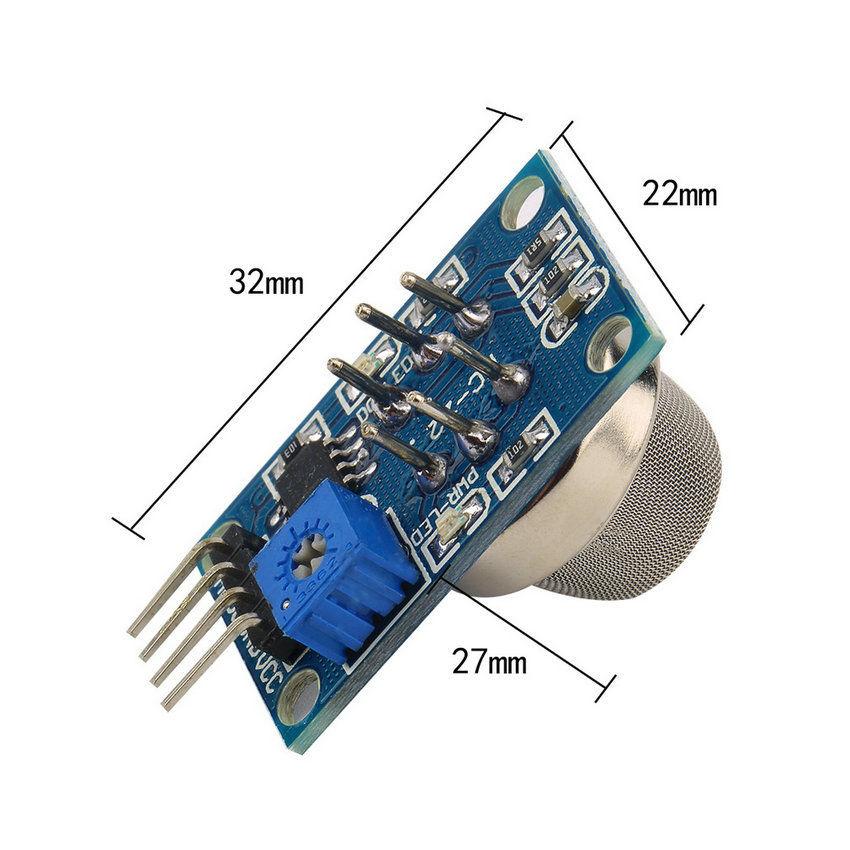


MQ-135 NH3 NOx Ammonia Alcohol Benzene Smoke CO2 Air Quality Gas Sensor Detector Module
MQ-135 NH3 NOx Ammonia Alcohol Benzene Smoke CO2 Air Quality Gas Sensor Detector Module
Couldn't load pickup availability
📋 Overview
The MQ-135 gas sensor detector module is designed for air quality monitoring, detecting a broad range of gases and vapors including ammonia (NH₃), nitrogen oxides (NOx), alcohol, benzene, smoke, and carbon dioxide (CO₂). Unlike other MQ-series sensors that focus on combustible or toxic gases, the MQ-135 is optimized for general air quality assessment — making it ideal for indoor environment monitoring, ventilation control, and pollution detection.
The module features dual signal outputs: an analog output (0V to ~5V) that increases with gas concentration, and a digital TTL output that signals when concentration exceeds an adjustable threshold. The threshold is easily set using the onboard potentiometer. With fast response and recovery characteristics, long service life, and reliable stability, the MQ-135 is suitable for both home and industrial use.
⭐ Key Features
- Air Quality Monitoring — Detects ammonia (NH₃), nitrogen oxides (NOx), alcohol, benzene, smoke, and CO₂
- Broad-Spectrum Detection — Responds to toxic gases, volatile organic compounds (VOCs), and smoke
- Dual Signal Output — Analog (AO) and digital TTL (DO) outputs for flexible integration
- Adjustable Threshold — Onboard potentiometer to set the digital output trigger level
- Indicator LEDs — Power LED and digital output (DO) status LED for visual feedback
- Fast Response & Recovery — Quick detection and return to baseline for reliable monitoring
- Simple 4-Pin Interface — VCC, GND, AO, DO — no library required
- 5V Compatible — Works directly with Arduino, ESP8266, and other 5V development boards
📊 Specifications
| Parameter | Value |
|---|---|
| Operating Voltage | 5V DC |
| Maximum Power Consumption | 800 mW (160 mA at 5V) |
| Detectable Gases | NH₃, NOx, alcohol, benzene, smoke, CO₂ |
| Analog Output (AO) | 0V to ~5V (proportional to gas concentration) |
| Digital Output (DO) | TTL level — LOW normally, HIGH when gas detected |
| Threshold Adjustment | Onboard potentiometer |
| Indicator LEDs | Power LED, DO (Digital Output) LED |
| Dimensions | Approx. 32 × 20 × 27 mm (1.25 x 0.8 x 1.1 inches) L × W × H |
| Weight | ~7 grams |
📦 What's in the Box
- 1x MQ-135 Air Quality Gas Sensor Detector Module
🔌 Compatible With
- Arduino (Uno, Mega, Nano, Pro Mini, and compatibles)
- ESP8266 and ESP32 development boards
- Raspberry Pi (with ADC module for analog reading)
- STM32, Teensy, and other 5V-compatible microcontrollers
- Any microcontroller with analog input and 5V power supply
🚀 Getting Started
- Connect VCC to 5V, GND to GND, AO to an analog input pin (e.g., A0), and DO to a digital input pin (e.g., D2)
- Upload a basic analogRead() sketch to your Arduino — no special library is required
- Open the Serial Monitor at 9600 baud and allow the sensor 2–5 minutes to warm up
- Observe the baseline reading in clean air, then introduce a gas source (exhale near the sensor, or hold rubbing alcohol nearby) to see the value increase
- Adjust the onboard potentiometer to set the digital output threshold for your application
💡 Tip: See our complete User Guide linked below for detailed wiring diagrams, pinout tables, sample code, and troubleshooting tips.
📌 Pinout
| Pin | Function |
|---|---|
| VCC | Power supply input — connect to +5V |
| GND | Ground |
| DO | Digital output — TTL HIGH when gas exceeds threshold |
| AO | Analog output — voltage proportional to gas concentration (0–5V) |
🎯 Typical Applications
- Indoor air quality monitoring (homes, offices, classrooms)
- Smart ventilation and HVAC control
- Ammonia detection in agricultural and livestock facilities
- Solvent and VOC monitoring in workshops and labs
- Smoke detection as a secondary indicator
- CO₂ trend monitoring (general indication)
- Air quality dashboards and IoT data logging
- Smart home automation — trigger alerts, fans, or air purifiers
- Educational and STEM projects
⚠️ Important Notes
- The sensor element gets hot during operation — do not touch the metal mesh cylinder while powered
- Allow a 24–48 hour initial burn-in for best accuracy on first use; subsequent warm-ups take only 2–5 minutes
- The MQ-135 is a broad-spectrum sensor — it cannot differentiate between individual gas types on its own
- Raw analog readings are not direct PPM values — calibration against known concentrations is required for PPM conversion
- For precise CO₂ measurement, use a dedicated NDIR CO₂ sensor; the MQ-135 provides general air quality indication
- The sensor draws up to 160 mA — use an external 5V supply if powering multiple sensors or experiencing unstable readings
📄 Documentation & Resources
- MQ-135 User Guide — Pinout, wiring, specifications, example code, schematic, and tips for reliable air quality monitoring
-
All Sensor, Detector & Input Module Guides
Sold and supported by Envistia Mall. Ships from the USA. For wiring diagrams and troubleshooting, see the User Guide. The manufacturer and Envistia LLC (dba Envistia Mall) are not responsible for any damages or losses resulting from the use of this product. Always follow proper electrical safety practices when working with electronic components. Specifications are based on manufacturer data and are subject to change without notice.
Share