



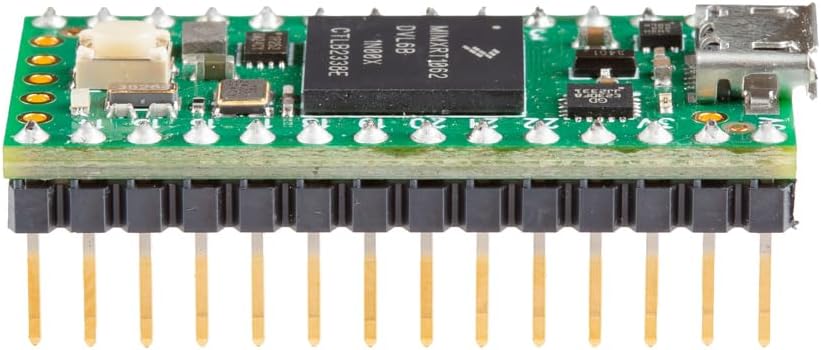
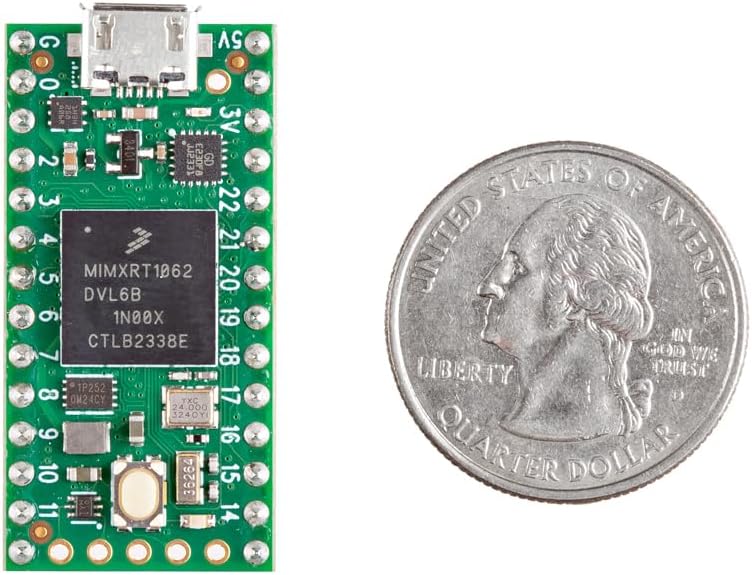
Teensy 4.0 ARM Cortex-M7 Microcontroller Development Board (Standard & Lockable Versions)
Teensy 4.0 ARM Cortex-M7 Microcontroller Development Board (Standard & Lockable Versions)
Couldn't load pickup availability
📋 Overview
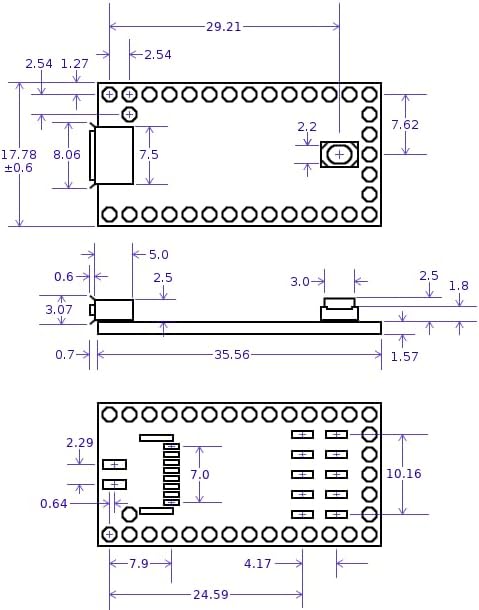
The Teensy 4.0 is a compact, high-performance microcontroller development board from PJRC, built around a 600 MHz ARM Cortex-M7 processor with 2MB of flash memory and 1MB of RAM. It delivers processing power that rivals many microcomputers — all packed into the same tiny, breadboard-friendly footprint as the popular Teensy 3.2, measuring just 1.4 × 0.7 inches.
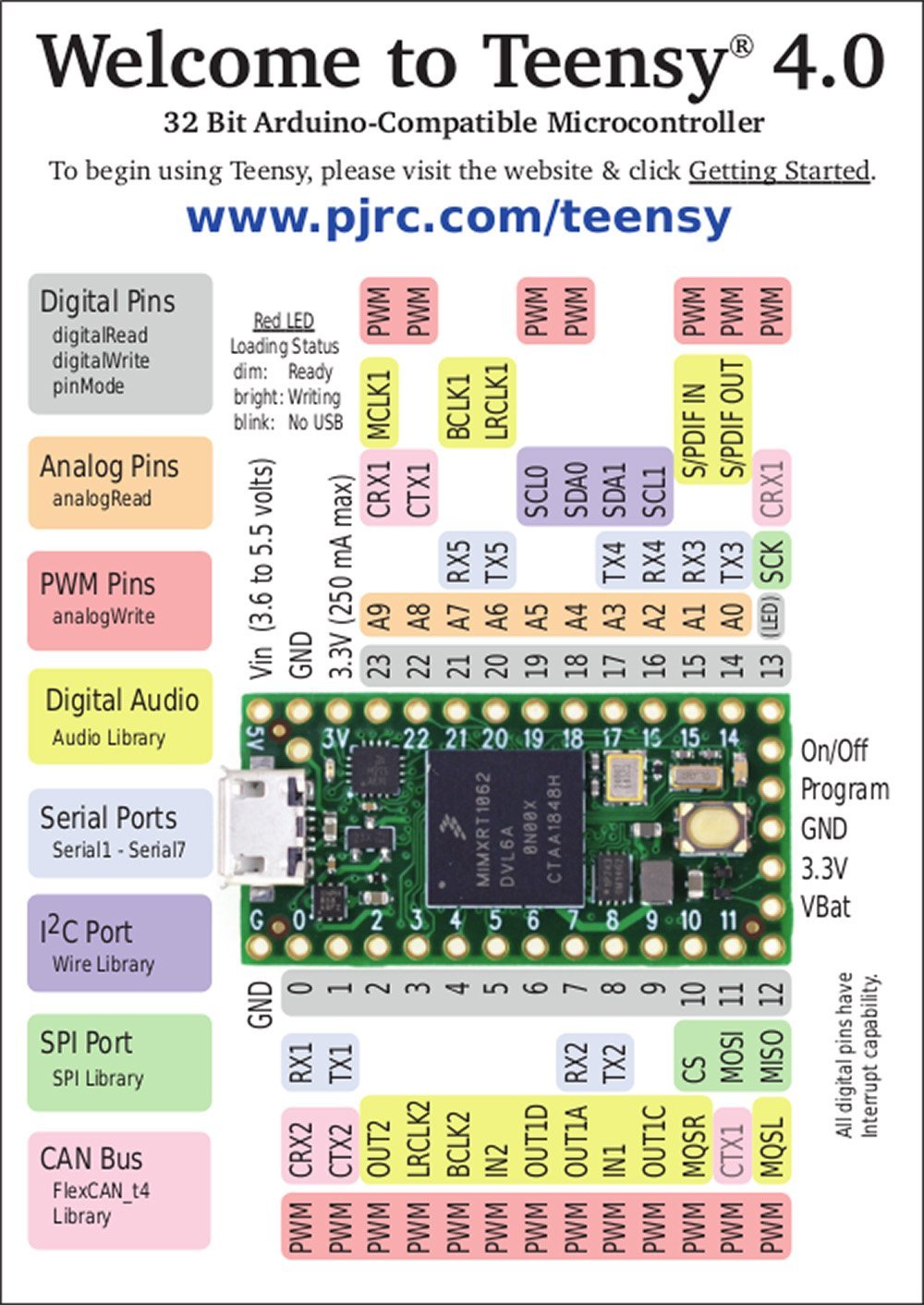
With 40 I/O pins, hardware floating point for both 32-bit and 64-bit math, 7 serial ports, 3 SPI, 3 I2C, 3 CAN Bus, and versatile USB device emulation, the Teensy 4.0 is ideal for projects that demand serious performance in the smallest possible package — all while remaining fully compatible with the Arduino IDE.
💡 Teensy 4.0 vs. Teensy 4.1: Both boards share the same 600 MHz processor and 1MB of RAM. The Teensy 4.1 is larger (2.4 × 0.7 in), has 4× more flash (8MB), and adds built-in Ethernet, a microSD card socket, USB host with power management, and more I/O pins. Choose the Teensy 4.0 when you need maximum performance in the smallest footprint, or as a drop-in upgrade from a Teensy 3.2.
🏪 Why Buy from Envistia Mall?
As an authorized PJRC/SparkFun reseller, our pricing is always competitive with other suppliers — and often better than distributors who mark these boards up at a premium.
- Competitive Pricing — No inflated markups. We price Teensy products competitively with the manufacturer's suggested retail price..
- User Guides & Documentation — Most products we sell include our own plain-English user guides with wiring diagrams and getting-started instructions, so you can get up and running quickly.
- Curated Accessories — We stock the compatible accessories you'll actually need — header pins, USB cables, and more — all in one place.
- Responsive Customer Support — We're here to help with orders, shipping, and general product questions. For in-depth technical questions, we'll connect you with the right resources.
- Fast US Shipping — We ship from the United States with quick handling times.
- Hassle-Free Returns — Simple, no-hassle return policy if something isn't right.
⭐ Key Features & Benefits
- 600 MHz ARM Cortex-M7 Processor — One of the fastest microcontrollers available. The dual-issue superscalar architecture can execute two instructions per clock cycle, delivering performance many times faster than typical 32-bit microcontrollers.
- 2MB Flash + 1MB RAM — Plenty of room for complex programs, with 512K of tightly coupled RAM for single-cycle access at full processor speed.
- Compact Teensy 3.2 Footprint — Same size and breadboard-friendly layout as the Teensy 3.2 (1.4 × 0.7 inches), making it a powerful drop-in upgrade for existing projects.
- Hardware Floating Point Unit (32 & 64-bit) — Full hardware acceleration for both single and double precision math. Functions like sin(), cos(), and log() execute at hardware speed — not through slow software emulation.
- 40 Digital I/O Pins (24 Breadboard-Friendly) — Extensive I/O capability including 31 PWM outputs, 14 analog inputs, 7 serial ports, 3 SPI, 3 I2C, and 3 CAN Bus ports.
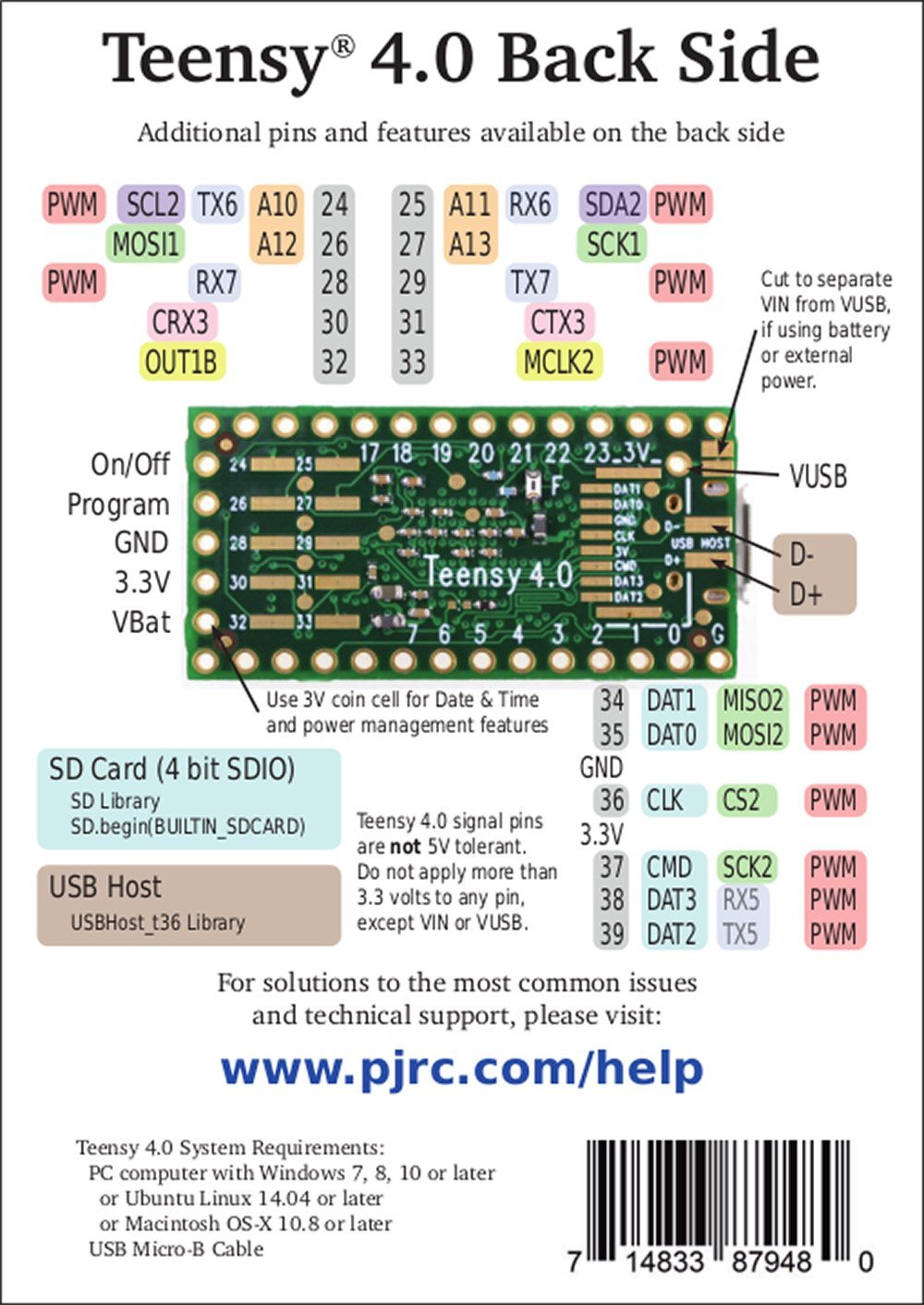
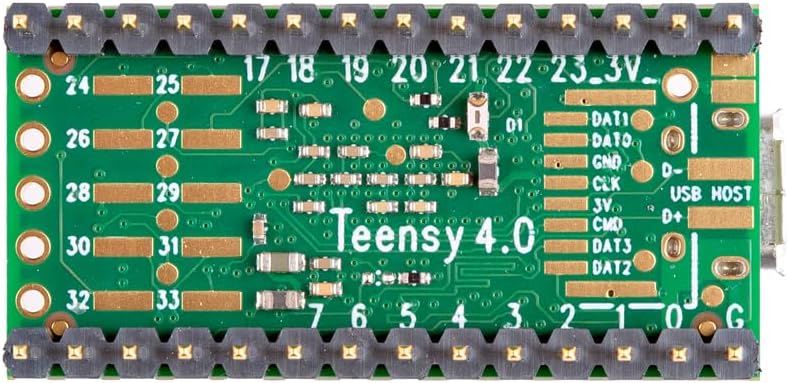
- USB Device (480 Mbit/s) + USB Host — The main USB port supports Serial, Keyboard, Mouse, MIDI, Joystick, Audio, and more. A secondary USB host port (via bottom SMT pads) lets you connect USB devices directly to the Teensy.
- Versatile USB Device Emulation — Appear as a keyboard, mouse, MIDI controller, joystick, audio device, flight sim controller, or multiple device types simultaneously.
- 32 DMA Channels — Hardware-accelerated data transfer for audio, LEDs, displays, and communication peripherals.
- Real-Time Clock (RTC) — Built-in RTC with dedicated 32.768 kHz crystal. Add a CR2032 coin cell to maintain date/time while powered off.
- Arduino IDE Compatible — Program with the familiar Arduino IDE using the Teensyduino add-on. Also supports PlatformIO, Visual Micro, CircuitPython, and command-line toolchains.
- Overclockable to 912 MHz — For projects that need even more speed, the Teensy 4.0 can be overclocked well beyond its rated 600 MHz.
- Cryptographic Acceleration & Random Number Generator — Built-in hardware security features.
🎯 Ideal Applications
- Multi-channel audio processing and synthesis (with the Teensy Audio Library and Audio Shield)
- Large-scale addressable LED installations (WS2812B/NeoPixel via OctoWS2811)
- Custom USB HID devices — keyboards, MIDI controllers, joysticks, flight sim panels
- CAN Bus automotive and industrial control projects
- Real-time signal processing and DSP
- Robotics and motor control (31 PWM channels)
- DMX lighting control
- Drop-in performance upgrade from Teensy 3.2
- Commercial and secure embedded products (Lockable variant available)
📊 Specifications
| Parameter | Value |
|---|---|
| Processor | NXP IMXRT1062 (ARM Cortex-M7), 144-pin package |
| Clock Speed | 600 MHz (overclockable to 912 MHz) |
| Floating Point Unit | Hardware 32-bit & 64-bit |
| Flash Memory | 2 MB (1984K usable for programs) |
| RAM | 1024K (512K tightly coupled) |
| EEPROM | 1080 bytes (emulated) |
| Digital I/O Pins | 40 total (24 breadboard-friendly + 16 bottom SMT pads) |
| PWM Outputs | 31 |
| Analog Inputs | 14 |
| Serial Ports | 7 (all with FIFOs) |
| SPI Ports | 3 |
| I2C Ports | 3 |
| CAN Bus | 3 (1 with CAN-FD) |
| USB | Device (480 Mbit/s) + Host (480 Mbit/s via bottom SMT pads) |
| Ethernet | None (available on Teensy 4.1) |
| SD Card | Via bottom SMT pads (SDIO) or SPI |
| Digital Audio | 2× I2S/TDM + 1× S/PDIF |
| DMA Channels | 32 |
| Operating Voltage | 3.3V (onboard regulator from 5V USB/VIN) |
| Input Voltage | 3.3V logic (not 5V tolerant) |
| Power Consumption | ~100 mA at 600 MHz |
| Board Dimensions | Approx. 36 × 18 mm (1.4 × 0.7 inches) L × W |
| Regulatory | FCC, ISED, CE, UKCA, RoHS, REACH compliant |
📦 What's in the Box
- 1× Teensy 4.0 Development Board (Standard or Lockable, depending on variant selected)
- 1× Pinout Reference Card
Note: Header pins and USB cable are sold separately.
🔧 Available Variants
| SKU | Variant | Best For |
|---|---|---|
| TEENSY40 | Standard | Prototyping, experimentation, learning |
| TEENSY40_LOCK | Lockable | Commercial products, secure applications |
The Lockable variant supports PJRC's Code Security features, including encrypted firmware updates, program memory protection, and JTAG disable — ideal for commercial products where intellectual property protection is critical.
💻 Software Compatibility
- Arduino IDE — Primary development environment with the Teensyduino boards add-on (installed via Boards Manager). Includes a large collection of optimized libraries.
- PlatformIO — Cross-platform IDE with advanced features. Supports Windows, Mac, and Linux.
- Visual Micro — Use Microsoft Visual Studio to program Teensy (Windows only, commercial software).
- CircuitPython — Python-based programming (partial hardware support).
- Command Line / Makefile — For non-graphical development workflows.
⚠️ Important Notes
- 3.3V Logic Only — All digital and analog pins operate at 3.3V. The pins are not 5V tolerant. Do not apply more than 3.3V to any pin.
- Header Pins Not Soldered — The board ships without header pins. Solder your own or purchase pre-soldered variants if available.
- USB Cable Required — A USB Micro-B cable is needed for programming and power (not included).
- USB Host Port — The USB host port is accessed via two small SMT pads on the bottom of the board (soldering required). Unlike the Teensy 4.1, there is no power management — do not hot-plug USB devices.
- SD Card Not Built In — SD card access is available via SPI (using a breakout board) or via bottom SMT pads (SDIO). For a built-in SD card socket, see the Teensy 4.1.
📄 Documentation & Resources
- User Guide: Envistia's Teensy 4.0 User Guide
- PJRC Official Product Page: Teensy 4.0 — Full Specifications & Technical Details
- PJRC Teensy Model Comparison: Compare All Teensy Models
- Teensyduino Software: Download Arduino IDE + Teensy Boards Add-on
- Processor Reference Manual: NXP IMXRT1060 Reference Manual (with PJRC annotations)
- All Teensy Products: Browse all Teensy Boards & Accessories at Envistia Mall
Sold and supported by Envistia Mall. Ships from the USA. For wiring diagrams, sample code, and troubleshooting, see the User Guide. The manufacturer and Envistia LLC (dba Envistia Mall) are not responsible for any damages or losses resulting from the use of this product. Always follow proper electrical safety practices when working with electronic components. Specifications are based on manufacturer data and are subject to change without notice.
Share


MMMMMMM Teensy :-)Sometimes a truly god-tier bit of tech comes out and I completely miss the memo. I think that's what happened here. If I may digress: Long ago, I was using serial port connected ADC chips on PC to do DIY electronics prototyping. I believe I was using Radio Skypipe back then if memory serves. Then eventually I discovered Arduino and was using that, again on PC to do live graphing of signals for projects. Then came the legendary Raspberry Pi and for the first time ever, was doing graphing on a dedicated computer. At first, it was the very overused MCP3008 ADC, then the MCP3304 which had 4x the resolution for the same sampling speed. All great! Limited to a mere <= 250ksps but great anyway.And then one day, very recently, I asked MS Copilot about options for higher sampling rate option. And Teensy was mentioned with great praise and numbers I had a hard time believing in. Just connect it to PC or Pi and have IT do the sampling, for up to and beyond 250ksps! What?? Ten times the speed?? BS, surely. I already had one for an upcoming audio project but I shelfed that project in favor of testing and holding MS Copilot to its once again wild claims of grandeur. Imagine my surprise when it turned out to be right! At first I had some problems, mainly with read noise, but I settled on a quick USB serial communication solution with 12 bit depth and 4x averaging at max possible speed for that approach, and easily got my 250ksps for a vastly superior result in data acquisition. The Teensy does the job of capture and serial broadcast, then a Python script receives that and sends it on to Python live plotting solutions over the LAN. Thus I can send the data to a local live grapher on Pi or PC, used for a slower 25 hour long term plot, and also simultaneously send the same data to any other machine on the network, which I use for realtime observation. These graphing programs run typically between 16 and 25 FPS due to limitations of the graphics speeds even on PC, but with a superior grapher I think I could go way beyond that. The data handling itself is stupid fast. Almost kinda oscilloscope fast. If I do a simpler grab-and-display frame based version of the grapher, it's good enough to look at the fluctuations inside a 1KHz and up sinewave, so it's getting it done nicely.So yes, for my application of abusing the Teensy as an ADC monster, it's a game changer. I've heard lots of people say it's an Arduino killer, and I believe it, although that seems a bit of an insult to this insanely capable little board. I haven't gone there yet, so I wouldn't know, but the specs don't lie and yeah, if you need a very capable little microcontroller then yes you need this at least to see if you can crack open your cage with it and fly away.The board itself connects to USB same as Arduino, and takes power from there. Once programmed, again same as Arduino but with a Teensy plugin, you can free yourself from USB tether and power it externally if you don't need USB communication. Using a no-power passthrough to eliminate USB power but keep USB data also works if you need to, but remember you must then use external power to run it. For crazy ADC people like me, know that there are ten total analog inputs for you to abuse and they are not SAR, so they don't contaminate each other's neighboring inputs requiring grounding or pull down resistors to prevent that. They just happily coexist. Each can also be set to specific bit depth resolutions and averaging in software. I started with 12-bit unsigned and 1x (no) averaging and got 30mV of read noise nothing would get rid of. Running at 4x averaging cut that down to just about 8mV, which is good enough for me and still gets me far faster sampling than my MCP series ADCs ever could. Faster sampling directly = cleaner data, and for the kind of fast transient work I often do, that is SO nice to have.These boards also do SPI if you need to play with that, a whopping 20 PWM pins, I2C and CAN bus. These are also widely used for advanced audio work like DSP (my eventual project is a realtime AGC box and maybe an eventual adaptive noise reduction box) with the available audio shield and audio libraries. The CPU on this thing is a fast single core running at default 600MHz but demonstrated to be stable overclocked at ~800MHz and experimentally driven to ~1GHz. Tight tight tight! Oh and they also have a micro SD card slot.I wish I had more to share about the vast array of applications this thing is good for, but I myself am just getting started. I'm sure there's more it can do than cannot. I'd love to see if it could pull off a basic audio streamer or even a webserver, and I'm sure I'll get there eventually.Also, the picture is my quickie electrometer design centered around an LMC6081 op amp IC and the Teensy for graphing the result. It's pretty hot, capable of detecting rubbed styro cups and human hair at several feet easy peasy. Power for the guts comes from external 12VDC to LM7085 5VDC...
I needed a STRONG device to run some complicated software for our ghost finders outfit that I build all of our investigative hardware for. This is the best controller out there for complicated functions such as true radar detection while still allowing the programing using the old Arduino frontend that I am used to using. I love it.
I use 4.0 & 4.1 in my projects... Tindie has nice breakout boards to speed up prototypes... run 528mhz so it stays cool... I put a small heat sink a nd cranked to 900+...worked but I'm sure it will reduce its life... The Teensydruino IDE works great as I have a 4.1, 4.0, and Ardruino uno connect via USB... I like them... bought mine with eternity, RTC, and SD... the SD recognizes Mt 1TB card... so cool.
So many good uses for this product. I just wish the USB port was secured better to the board. Already replaced one because the solder broke. To be fair, I was rough with it and could have fixed it but at this price, I didn't bother.
I first purchased the Teensy 4.1 a while ago, and it was amazing, the features were out of the window, and everything was amazing. I first initially bought it for a calculator I was working on, but now I bought this Teensy 4.0 as sort of a co-processor that works along side with my originally purchased Teensy 4.1 for double the processing power.Powerful processor, neat compact design, and great for things like camera setups and advanced projects.
Reviews in Other Languages
Plug and play. Thanks.