

SystemBase sLAN/all-PoE Serial to Ethernet Converter (RS-232/422/485) with Power over Ethernet
SystemBase sLAN/all-PoE Serial to Ethernet Converter (RS-232/422/485) with Power over Ethernet
Couldn't load pickup availability
Ultra-Compact Serial Networking Solution with PoE
Connect any serial device to your Ethernet network - RS-232, RS-422, or RS-485 - with one versatile, industrial-grade converter. Powered directly from your network switch via PoE (Power over Ethernet).
The SystemBase sLAN/all-PoE is the professional's choice for serial-to-Ethernet conversion with Power over Ethernet capability. With support for all three major serial standards, IEEE 802.3af PoE, ultra-compact design, and industrial-grade reliability, this converter handles any serial networking challenge while eliminating the need for separate power adapters.
Why the sLAN/all-PoE is Your Best Investment
⚡ Power over Ethernet (PoE)
Eliminate separate power adapters entirely. The sLAN/all-PoE draws power directly from your PoE-enabled network switch via IEEE 802.3af standard. One cable provides both data and power—perfect for remote installations and clean cable management.
🔄 Ultimate Versatility
One device supports RS-232, RS-422, AND RS-485. No need to stock multiple converter types—the sLAN/all-PoE adapts to any serial interface with simple software configuration.
📦 Ultra-Compact Design
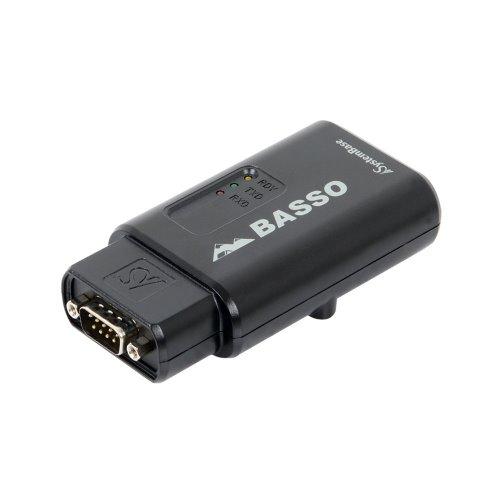
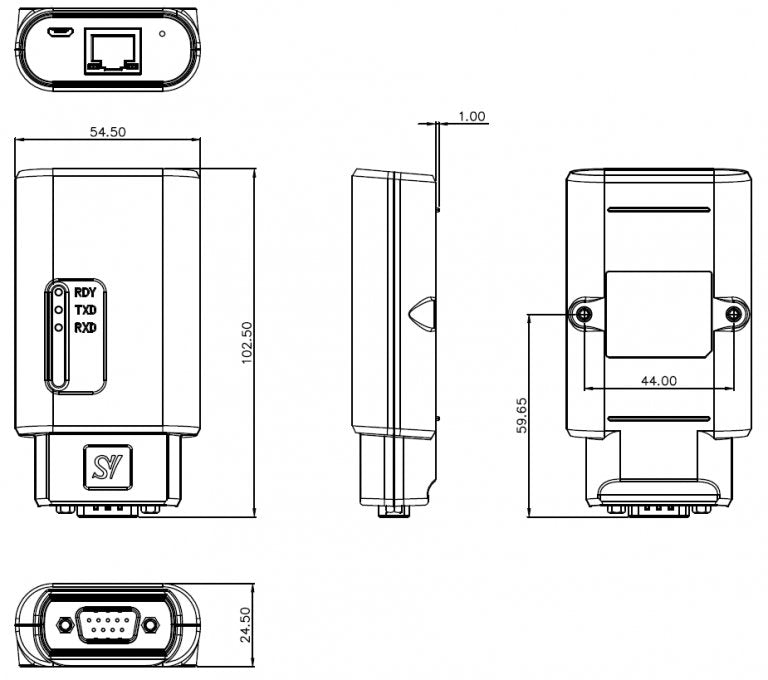
At just 54.5mm x 102.5mm x 24.5mm and weighing only 79g, the sLAN/all-PoE is one of the smallest PoE-enabled serial-to-Ethernet converters available. Perfect for space-constrained installations.
💪 Industrial-Grade Durability
Built to withstand extreme environments with an operating temperature range of -40°C to 85°C (non-PoE) or -20°C to 70°C (PoE mode). Designed for continuous 24/7/365 operation in demanding industrial settings.
🚀 High-Speed Performance
Support for baud rates up to 921.6 kbps ensures fast, reliable data transfer. RS-422/485 modes support long-distance communication up to 4,000 feet (1,200m).
🛡️ Maximum Protection
- ±15kV IEC ESD protection on all serial lines
- Surge and EFT protection per KS C standards
- Built-in termination resistors for RS-422/485
🎯 Plug-and-Play Simplicity
Web-based configuration, automatic device discovery with SGConfig utility, and virtual COM port software make setup effortless—even for complex multi-drop RS-485 networks.
🔌 Dual Power Options
Use PoE for clean installations or fall back to Micro-USB power (5V DC) when PoE isn't available. Maximum flexibility for any deployment scenario.
sLAN/All POE Technical Specifications
Serial Interface Options
RS-232 Mode:
- Port: 1 x RS-232 (DB9 Male connector)
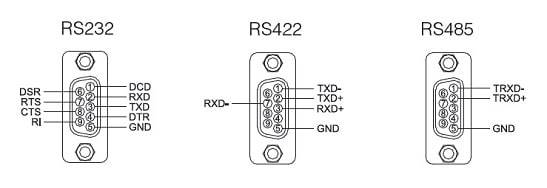
- Signals: TXD, RXD, RTS, CTS, DTR, DSR, DCD, RI, GND
- Maximum Distance: 50 feet (15m)
- Full duplex communication
RS-422 Mode:
- Port: 1 x RS-422 (DB9 Male connector)
- Signals: TXD+, TXD-, RXD+, RXD-, GND
- Maximum Distance: 4,000 feet (1,200m)
- Full duplex communication
- Multi-drop mode: Master/Slave configuration supported
RS-485 Mode:
- Port: 1 x RS-485 (DB9 Male connector)
- Signals: TRXD+, TRXD-, GND
- Maximum Distance: 4,000 feet (1,200m)
- Half duplex communication
- Multi-drop support: Up to 32 devices per network
- Built-in termination resistors (120Ω) - Enable/Disable via software
Common Serial Parameters (All Modes)
- Maximum Baud Rate: 921.6 kbps
- Supported Baud Rates: 150, 300, 600, 1200, 2400, 4800, 9600, 19200, 38400, 57600, 115200, 230400, 460800, 921600 bps
- Data Bits: 5, 6, 7, 8
- Stop Bits: 1, 2
- Parity: None, Even, Odd
- Flow Control: None, RTS/CTS (RS-232 mode only), XON/XOFF
Network Interface
- Ethernet Port: 1 x 10/100 Mbps Auto-MDIX (RJ-45 with PoE PD function)
- Network Protocols: TCP, UDP, ICMP, DHCP, HTTP, IPv4
-
Operating Modes:
- COM Redirector - Virtual COM port functionality
- TCP Server - Listen for incoming connections
- TCP Client - Connect to remote host
- UDP Server - Receive UDP packets
- UDP Client - Send UDP packets
- IP Configuration: Static IP or DHCP (Dynamic IP)
- Default IP Address: 192.168.0.223
- Connection Management: Multiple simultaneous connections
- Security: Password-protected configuration (Default ID: slan, PW: 99999999)
Power Specifications
Power over Ethernet (PoE) - Primary:
- Standard: IEEE 802.3af (PoE PD - Powered Device)
- Input Voltage: 48V DC from PoE switch/injector
-
Power Consumption:
- Operating & Standby: 0.6W
- Operating Temperature (PoE mode): -20°C to 70°C (-4°F to 158°F)
Micro-USB Power - Backup/Alternative:
- Input Voltage: 5V DC via Micro-USB Type B connector
-
Power Consumption:
- Maximum: 1.2W
- Operating: 1.0W
- Standby: 0.9W
- Operating Temperature (USB mode): -40°C to 85°C (-40°F to 185°F)
Note: Device can be powered by either PoE or Micro-USB (not simultaneously required)
Protection & Reliability
- ESD Protection: ±15kV IEC standard on all serial lines
-
Standards Compliance:
- KS C 9610-4-2 (ESD)
- KS C 9610-4-4 (EFT)
- KS C 9610-4-5 (Surge)
Configuration & Management
-
Setup Methods:
- Web-based configuration interface (HTTP)
- SGConfig utility (Windows 7 or above)
- TestView testing software
-
Software Included:
- COM Port Redirector (Virtual COM Port driver)
- SGConfig (Configuration utility)
- TestView (Testing and diagnostics)
-
Status Indicators:
- RDY (Yellow) - Blinks during operation
- TXD (Green) - Blinks when transmitting serial data
- RXD (Red) - Blinks when receiving serial data
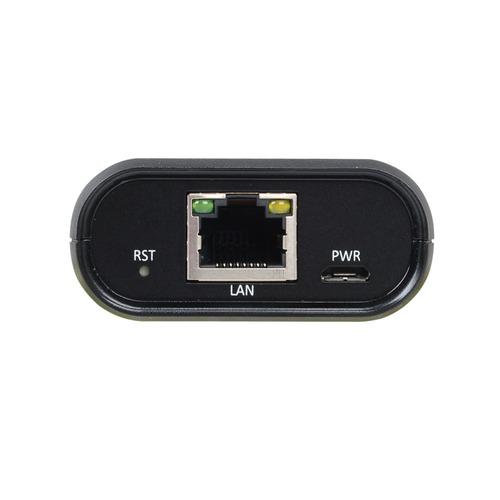
- LAN Port LEDs - Yellow (100Mbps Link/Activity), Green (10Mbps Link/Activity)
- Reset Button: Press < 3 seconds to reboot, > 3 seconds for factory reset
- Firmware Updates: Remote updates via web interface
Environmental Specifications
-
Operating Temperature:
- PoE Mode: -20°C to 70°C (-4°F to 158°F)
- USB Mode: -40°C to 85°C (-40°F to 185°F)
- Storage Temperature: -40°C to 85°C
- Humidity: 5% to 95% RH, non-condensing
- Certifications: CE, FCC Class A (Industrial use), RoHS compliant
Physical Specifications
- Dimensions: 54.5mm (W) x 102.5mm (L) x 24.5mm (H) (2.15" x 4.04" x 0.96")
- Weight: 79g (2.79 oz)
- Mounting: Desktop (compact footprint)
- Enclosure: Industrial-grade plastic housing
-
Connectors:
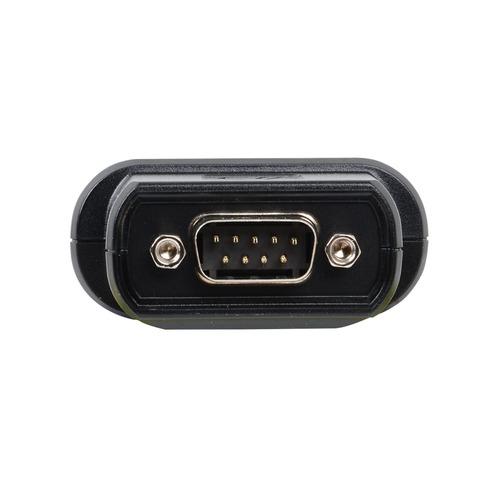
- 1 x DB9 Male (RS-232/422/485)
- 1 x RJ-45 (Ethernet with PoE PD)
- 1 x Micro-USB Type B (Power input - alternative to PoE)
- 1 x Reset button (Tact switch)
Real-World Applications
🏭 Industrial Automation & SCADA
- Connect PLCs, RTUs, and industrial controllers to SCADA systems
- Multi-drop RS-485 networks for sensor arrays and I/O modules
- Remote monitoring and control of manufacturing equipment
- Building automation and energy management systems
- Factory floor data collection and distribution
- Robot arms and human-machine interfaces
- Logistics warehouse rail systems
🏥 Healthcare & Medical Equipment
- Network legacy diagnostic equipment and patient monitors
- Laboratory automation and LIMS integration
- Medical imaging device connectivity
- Examination equipment controllers
- Measuring instruments and gas detectors
- Hospital infrastructure management
🚂 Transportation & Infrastructure
- Railway signaling and control systems
- Traffic management and ITS (Intelligent Transportation Systems)
- Airport ground support equipment
- Parking management and access control
- Logistics and conveyor belt systems
⚡ Energy & Utilities
- Smart grid monitoring and control
- Power management devices
- Remote meter reading (AMR/AMI)
- Water quality and pollution measuring instruments
- Environmental monitoring stations
📡 Telecommunications
- Serial console access to network equipment
- Remote management of telecom infrastructure
- Base station monitoring and control
- Network operations center (NOC) equipment
🏪 Retail & Point of Sale
- Card readers and barcode scanners
- POS devices and kiosks
- Serial printers and ATM machines
- Credit card terminals and readers
- Inventory management systems
🔬 Laboratory & Research
- Network analytical instruments and data loggers
- Controllers on inspection equipment
- Automated testing equipment
- Quality control systems
- Research data acquisition
🏗️ Security & Access Control
- Biometric sensors and alarm devices
- Card readers and access control panels
- CCTV camera control (PTZ)
- Intrusion detection systems
- Security devices
🎮 Consumer Electronics & Home Automation
- Game console connectivity
- Home appliance networking
- Power management devices
- Data collection and distribution devices
What's in the Box
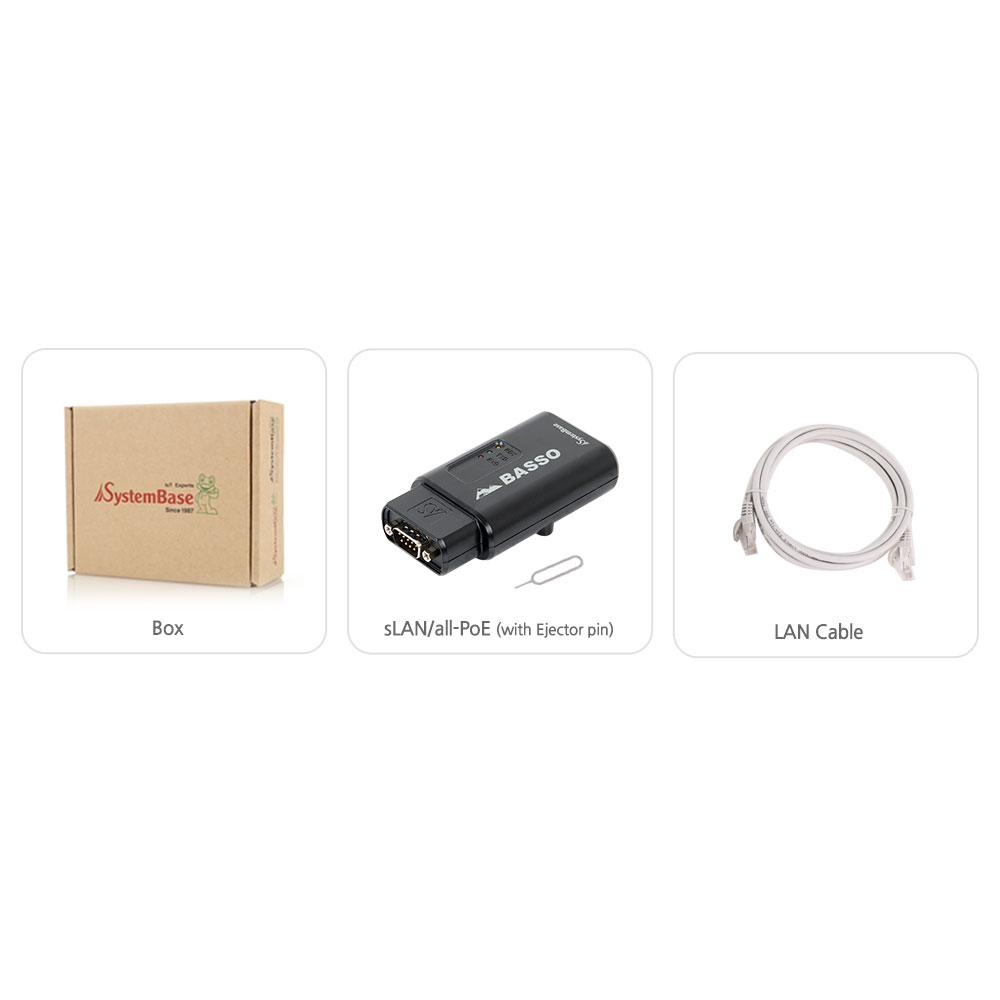
✓ sLAN/all-PoE Serial to Ethernet Converter (1 unit)
✓ LAN Cable (Ethernet cable)
✓ Ejector Pin (for DB9 connector)
✓ Product Warranty & Download Guide
✓ Software available for download:
- COM Port Redirector (Virtual COM Port driver)
- SGConfig (Configuration utility)
- TestView (Testing software)
- User manual (PDF)
Note: PoE injector sold separately if your network switch doesn't support PoE. Micro-USB power cable not included (standard 5V Micro-USB cable can be used if PoE is unavailable).
All software is available for download from the SystemBase website. See the link under the Technical Support & Resources section below.
Quick Setup Guide
Step 1: Choose Your Power Source
Option A - Power over Ethernet (Recommended):
- Connect Ethernet cable from PoE-enabled switch (IEEE 802.3af) to sLAN/all-PoE
- Device powers on automatically
- RDY LED will blink when device is operating
- Operating temperature range: -20°C to 70°C
Option B - Micro-USB Power:
- Connect 5V DC power via Micro-USB Type B connector
- Connect standard Ethernet cable (non-PoE)
- RDY LED will blink when device is operating
- Operating temperature range: -40°C to 85°C
Step 2: Choose Your Serial Interface
The sLAN/all-PoE uses a single DB9 Male connector that supports all three serial modes. Configure the interface type via the web interface or SGConfig utility.
For RS-232:
- Connect your RS-232 device to the DB9 port
- Configure Interface setting to "RS-232" in web interface
- Pins: TXD(3), RXD(2), RTS(7), CTS(8), DTR(4), DSR(6), DCD(1), RI(9), GND(5)
For RS-422:
- Connect your RS-422 device to the DB9 port
- Configure Interface setting to "RS-422" in web interface
- Configure RS-422 Multi-Drop Mode (Master or Slave)
- Pins: TXD+(2), TXD-(1), RXD+(3), RXD-(7), GND(5)
For RS-485:
- Connect your RS-485 device to the DB9 port
- Configure Interface setting to "RS-485" in web interface
- Enable/disable termination resistor as needed
- Pins: TRXD+(2), TRXD-(1), GND(5)
Step 3: Network Configuration
Option A - Use Default IP Address:
- Configure your PC to access 192.168.0.x network
- Open web browser and navigate to http://192.168.0.223
- Login with default credentials (ID: slan, Password: 99999999)
Option B - Use SGConfig Utility:
- Run SGConfig on Windows PC
- Click [Search] to discover sLAN/all-PoE devices on network
- Select device and click [Configure]
Important: Web configuration requires 100Mbps network connection. For 10Mbps networks, use SGConfig utility instead.
Step 4: Configure Settings
- Network Settings: Set Static IP or DHCP, configure IP address, subnet mask, gateway
- Operation Settings: Select operation mode (COM Redirector, TCP Server/Client, UDP Server/Client)
- Serial Settings: Configure interface (RS-232/422/485), baud rate, data bits, stop bits, parity, flow control
- Click [Submit] to save changes
- Click [Reboot] to apply settings
Step 5: Test & Deploy
- Use TestView software to verify communication
- Install COM Port Redirector if using virtual COM port mode
- Monitor status via web interface or SGConfig
Total setup time: 5-10 minutes
Advanced Features & Capabilities
Power over Ethernet Benefits
Simplified Installation:
- Single cable for both data and power
- No need for nearby AC outlets
- Reduced installation time and cost
- Cleaner, more professional installations
Remote Locations:
- Power devices where AC power isn't available
- Ceiling-mounted installations
- Outdoor enclosures (with weatherproof housing)
- Hard-to-reach locations
Centralized Power Management:
- UPS backup for all PoE devices from central location
- Remote power cycling via managed PoE switches
- Power monitoring and management
- Reduced power adapter inventory
Flexibility:
- Fall back to Micro-USB power if PoE unavailable
- Mix PoE and non-PoE installations as needed
- Compatible with any IEEE 802.3af PoE source
Flexible Serial Interface Selection
The sLAN/all-PoE uses a single DB9 connector that supports all three serial standards:
- Software configuration - Switch between RS-232, RS-422, and RS-485 via web interface
- No hardware jumpers - All configuration done through software
- Pin mapping - Automatic pin assignment based on selected interface
- Hot-swappable between modes (after reboot)
RS-485 Multi-Drop Networking
Perfect for industrial applications requiring multiple devices on one network:
- Support for up to 32 devices per RS-485 bus
- Software-configurable termination resistors (120Ω)
- Half-duplex communication
- Transparent data transmission
- Compatible with Modbus RTU, Profibus, BACnet MS/TP, and other protocols
RS-422 Multi-Drop Mode
Unique RS-422 multi-drop capability:
- Master mode: For primary controller
- Slave mode: For secondary devices
- Point-to-point: Set both devices to Master for 1:1 connections
- Full-duplex communication
- Long-distance support up to 4,000 feet
Virtual COM Port Technology
The included COM Port Redirector creates virtual COM ports on Windows systems:
- Legacy applications work without modification
- Supports multiple virtual ports simultaneously
- Automatic reconnection on network interruption
- Compatible with Windows 7 and above
Multiple Operating Modes
COM Redirector Mode:
- Creates virtual COM port on Windows PC
- Serial port settings follow virtual COM port configuration
- Perfect for legacy software compatibility
- No application changes required
TCP Server Mode:
- Device listens for incoming connections on configured port (default: 4001)
- Multiple clients can connect simultaneously
- Transparent data transfer between socket and serial port
- Ideal for centralized monitoring applications
TCP Client Mode:
- Device initiates connection to remote server
- Configure target IP address and port
- Automatic reconnection on network interruption
- Perfect for data logging and cloud integration
UDP Server Mode:
- Receives UDP packets on configured port
- Forwards data to serial port
- Sends serial data as UDP packets to client
- Low-latency communication
UDP Client Mode:
- Sends serial data as UDP packets to configured server
- Configure target IP address and port
- Ideal for broadcast/multicast applications
Intelligent Data Handling
Latency Time Configuration:
- Set to 0 for real-time operation (immediate forwarding)
- Set to non-zero to buffer data and reduce network traffic
- Configurable in milliseconds
- Balances real-time performance vs. network efficiency
TCP Alive Check:
- Monitors network connection health at configured intervals (default: 60 seconds)
- Automatically terminates/resets failed connections
- Configurable from 0-65,535 seconds
- Set to 0 to disable
TCP No-Delay Option:
- Disabled: Buffers TCP data before processing (better for high-speed/packet-based)
- Enabled: Processes TCP data immediately (minimizes delay)
- Optimizes for different application requirements
Network Discovery & Management
- Automatic device discovery via SGConfig utility
- Web-based configuration accessible from any browser (requires 100Mbps connection)
- Password protection for secure access
- Factory reset via reset button (press > 3 seconds)
- Remote firmware updates via web interface
- Real-time status monitoring with LED indicators
Auto-MDIX Support
- Automatically detects straight or crossover Ethernet cables
- No need for specific cable types
- Simplifies installation and reduces errors
Software Suite
COM Port Redirector (Virtual COM Port Driver)
Creates virtual COM ports on Windows systems, allowing legacy serial applications to communicate over the network without modification.
Features:
- Multiple virtual COM ports per device
- Automatic reconnection
- Flow control support
- Compatible with Windows 7 and above
How it works: When Operation Mode is set to "COM Redirector," the sLAN/all-PoE serial port appears as a local COM port on your Windows PC. Your existing serial software works without any changes.
SGConfig Configuration Utility
Comprehensive Windows application for device management:
Features:
- Automatic device discovery on network
- Intuitive GUI for all configuration parameters
- Batch configuration for multiple devices
- Real-time monitoring and diagnostics
- Configuration backup and restore
- Compatible with Windows 7 and above
- Works with both 10Mbps and 100Mbps networks
TestView Testing Software
Professional testing and diagnostic tool:
Features:
- Serial port communication testing
- Network connectivity verification
- Data transmission monitoring
- Protocol analysis
- Performance benchmarking
- Troubleshooting wizards
RS-485 Configuration Guide
Termination Resistors
RS-485 networks require 120Ω termination resistors at both ends of the bus:
- Enable termination on the first and last devices only via web interface
- Disable termination on all middle devices
- Software-configurable (no hardware jumpers required)
- Improper termination causes communication errors
Wiring Best Practices
- Use twisted pair cable (Cat5e or better, or dedicated RS-485 cable)
- Keep total bus length under 4,000 feet (1,200m)
- Use daisy-chain topology (not star)
- Avoid stubs longer than 1 meter
- Maintain proper grounding to prevent ground loops
- Use shielded cable in electrically noisy environments
Pin Assignment for RS-485
- Pin 1: TRXD- (Data-)
- Pin 2: TRXD+ (Data+)
- Pin 5: GND (Ground)
Multi-Drop Addressing
For RS-485 networks with multiple devices:
- Each device needs a unique address (configured in serial device)
- sLAN/all-PoE acts as transparent bridge (no addressing required)
- Use Modbus RTU, Profibus, or other multi-drop protocols
- Configure appropriate timeout values for polling applications
RS-422 Multi-Drop Configuration
Master/Slave Mode
The sLAN/all-PoE supports RS-422 multi-drop configurations:
Master Mode:
- Set for the primary controller device
- Transmits data to multiple slave devices
Slave Mode:
- Set for secondary devices
- Receives data from master
Point-to-Point (1:1):
- Set both connected devices to Master mode
- Standard RS-422 full-duplex communication
Pin Assignment for RS-422
- Pin 1: TXD- (Transmit-)
- Pin 2: TXD+ (Transmit+)
- Pin 3: RXD+ (Receive+)
- Pin 7: RXD- (Receive-)
- Pin 5: GND (Ground)
PoE Deployment Guide
PoE Switch Requirements
The sLAN/all-PoE requires an IEEE 802.3af compliant PoE source:
- PoE Standard: IEEE 802.3af (PoE, not PoE+)
- Power Class: Class 0 (0.44W to 12.95W)
- Actual Consumption: 0.6W (operating & standby)
- Voltage: 48V DC nominal
Compatible PoE Sources
Managed PoE Switches:
- Enterprise-grade switches with per-port PoE management
- Remote power cycling capability
- Power monitoring and budgeting
- VLAN and QoS support
Unmanaged PoE Switches:
- Simple plug-and-play operation
- Lower cost for small deployments
- No configuration required
PoE Injectors (Midspan):
- Single-port PoE injectors for non-PoE switches
- Multi-port injectors for multiple devices
- Ideal for adding PoE to existing infrastructure
Cable Requirements
- Cable Type: Cat5e or better (Cat6, Cat6a recommended)
- Maximum Length: 100 meters (328 feet) per IEEE 802.3af standard
- Shielding: Use shielded cable in electrically noisy environments
- Quality: Use quality cables to ensure reliable PoE delivery
Temperature Considerations
PoE Mode Operating Range: -20°C to 70°C (-4°F to 158°F)
- Most industrial environments fall within this range
- For extreme cold (< -20°C), use Micro-USB power instead
- For extreme heat (> 70°C), use Micro-USB power instead
- PoE mode provides adequate range for most applications
USB Mode Operating Range: -40°C to 85°C (-40°F to 185°F)
- Extended range for extreme environments
- Use when PoE temperature limits are exceeded
- Requires separate power adapter
Frequently Asked Questions
Q: What's the difference between the sLAN/all-PoE and the sLAN/All?
A: The sLAN/all-PoE includes Power over Ethernet (IEEE 802.3af) capability, allowing it to be powered directly from a PoE switch. The V2.0 model requires external 5V DC power. The PoE model is also slightly larger (102.5mm vs 72mm length) to accommodate PoE circuitry. Both models have identical serial and network capabilities.
Q: Do I need a PoE switch, or can I use a PoE injector?
A: Either works! You can use a PoE-enabled network switch or a PoE injector (IEEE 802.3af). PoE injectors are ideal for adding PoE capability to existing non-PoE switches.
Q: Can I use regular (non-PoE) Ethernet and power it via Micro-USB?
A: Yes! The sLAN/all-PoE has dual power options. You can use PoE for clean installations or Micro-USB (5V DC) when PoE isn't available. This provides maximum deployment flexibility.
Q: What's the operating temperature range when using PoE?
A: When powered by PoE, the operating temperature range is -20°C to 70°C (-4°F to 158°F). When powered by Micro-USB, the range extends to -40°C to 85°C (-40°F to 185°F).
Q: How much power does the sLAN/all-PoE consume?
A: Very little! PoE mode consumes only 0.6W (operating & standby). USB mode consumes 1.0W operating, 0.9W standby, with a maximum of 1.2W. This makes it extremely energy-efficient.
Q: How do I switch between RS-232, RS-422, and RS-485 modes?
A: All configuration is done through software via the web interface or SGConfig utility. Simply select the desired interface type in the Serial Settings page and reboot the device. No hardware jumpers required.
Q: What's the maximum number of devices on an RS-485 network?
A: The sLAN/all-PoE supports up to 32 devices per RS-485 bus. For larger networks, use RS-485 repeaters.
Q: Can I configure the device via web browser on a 10Mbps network?
A: No, web configuration requires a 100Mbps network connection. For 10Mbps networks, use the SGConfig utility instead, which works with both 10Mbps and 100Mbps connections.
Q: What operating systems are supported?
A: The device works with any OS that supports TCP/IP (Windows, Linux, macOS, Unix, etc.). The COM Port Redirector and SGConfig utilities require Windows 7 or above, but the web interface works in any modern browser.
Q: How do I reset the device to factory defaults?
A: Press and hold the RST button on the rear panel for more than 3 seconds. The device will reset to factory default settings (IP: 192.168.0.223, ID: slan, Password: 99999999).
Q: Can I use straight or crossover Ethernet cables?
A: Either! The sLAN/all-PoE supports Auto-MDIX, which automatically detects and adapts to both cable types.
Q: What is the default IP address?
A: The default IP address is 192.168.0.223 with subnet mask 255.255.255.0 and gateway 192.168.0.254.
Technical Support & Resources
- Download the sLAN/All POE User Manual (PDF)
- Download Configuration Software and Utilities (SystemBase Website)
Need help? Contact our technical support team at support@envistiamall.com
Share
