



12V (8-24V) To 3.3V 3A DC-DC Waterproof Step-Down Converter Power Supply Module F23J3V3A4S
12V (8-24V) To 3.3V 3A DC-DC Waterproof Step-Down Converter Power Supply Module F23J3V3A4S
Couldn't load pickup availability
📋 Overview
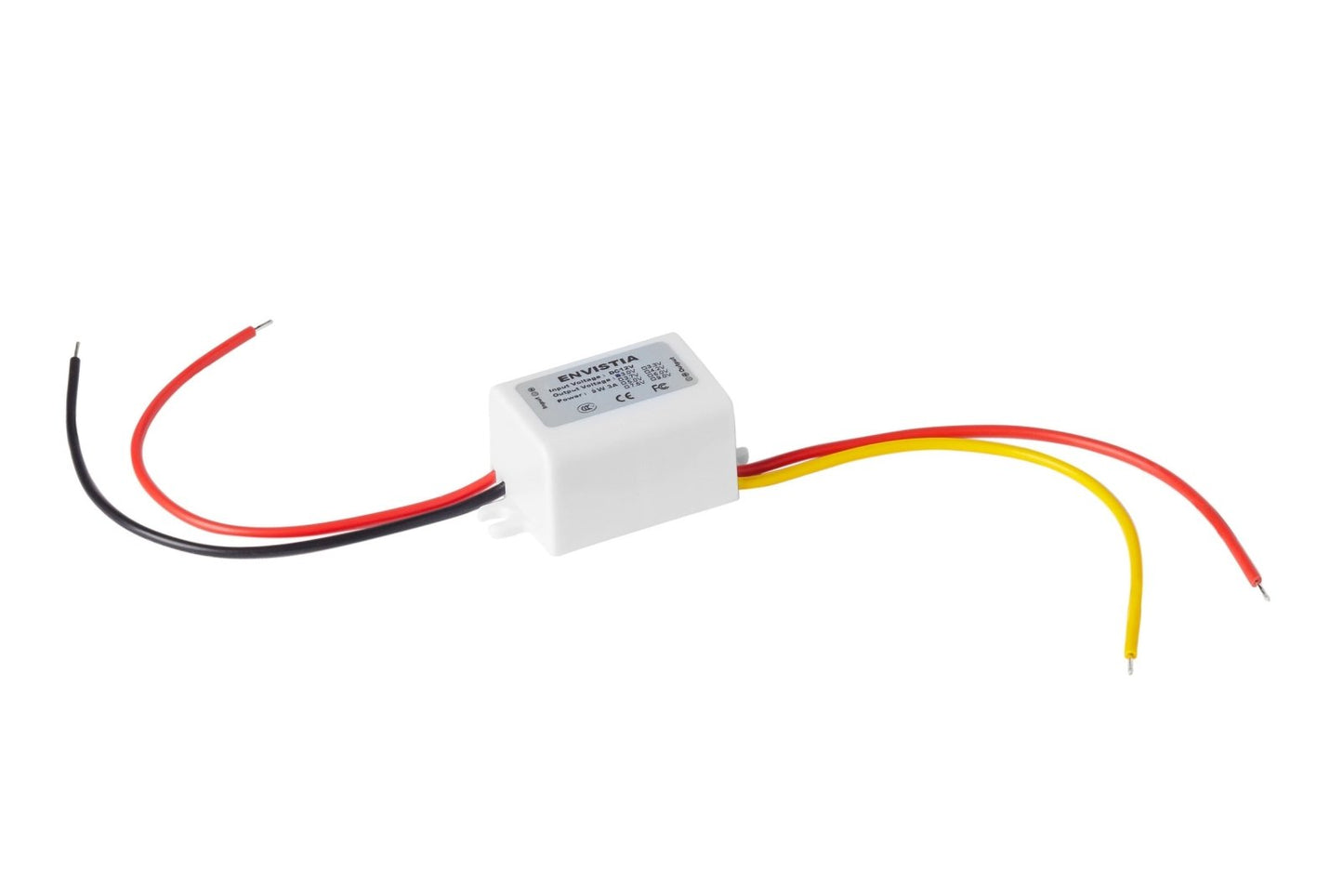
This miniature DC-DC step-down converter takes an 8–24V DC input (nominally 12V) and delivers a clean, regulated 3.3V DC output at up to 3A (9W maximum). It's a waterproof, straightforward way to power 3.3V electronics — sensors, microcontrollers, cameras, and more — directly from a 12V battery, vehicle system, or wall adapter.
Built as a non-isolated buck (step-down) converter, it operates at over 96% efficiency, so very little power is wasted as heat even under full load. The epoxy-sealed housing makes it safe for outdoor, automotive, or otherwise exposed installations.
⭐ Key Features
- Regulated 3.3V output — Clean, stable power for 3.3V-logic devices and sensors
- Wide input range — Accepts 8–24V DC, ideal for 12V nominal systems with voltage sag or charging spikes
- Epoxy-sealed, waterproof housing — Safe for outdoor, automotive, and marine use
- High efficiency — Greater than 96% efficient, minimal heat generation
- Built-in protection — Overload, over-current, over-voltage, and low-voltage protection with automatic recovery
- Compact and lightweight — Easy to tuck into enclosures, dashboards, or inline wiring runs
📊 Specifications
| Specification | Value |
|---|---|
| Envistia Model Number | F23J3V3A4S |
| Input Voltage Range | 8–24V DC |
| Nominal Input | 12V DC |
| Output Voltage | 3.3V (+2%/-10%) |
| Max Output Current | 3A |
| Max Output Power | 9W |
| Approx. Max Input Current (at full load, 12V in) | ~0.75A |
| Quiescent Current (no load) | <10mA |
| Efficiency | >96% |
| Operating Temperature | -40°C to +70°C |
| Size (L × W × H) | Approx. 38 × 27 × 23 mm (1.50 × 1.06 × 0.91 inches) L × W × H (52 mm / 2.05 inches overall length including mounting tabs) |
| Weight | Approx. 30g |
| Input & Output Wire Length | Approx. 12cm (4.7 inches) per lead |
| Input & Output Wire Size | 0.5mm² cross-sectional area, equivalent to ~20 AWG |
| Case Color | White |
| Housing | Epoxy-sealed, waterproof |
🔌 Wiring & Connections
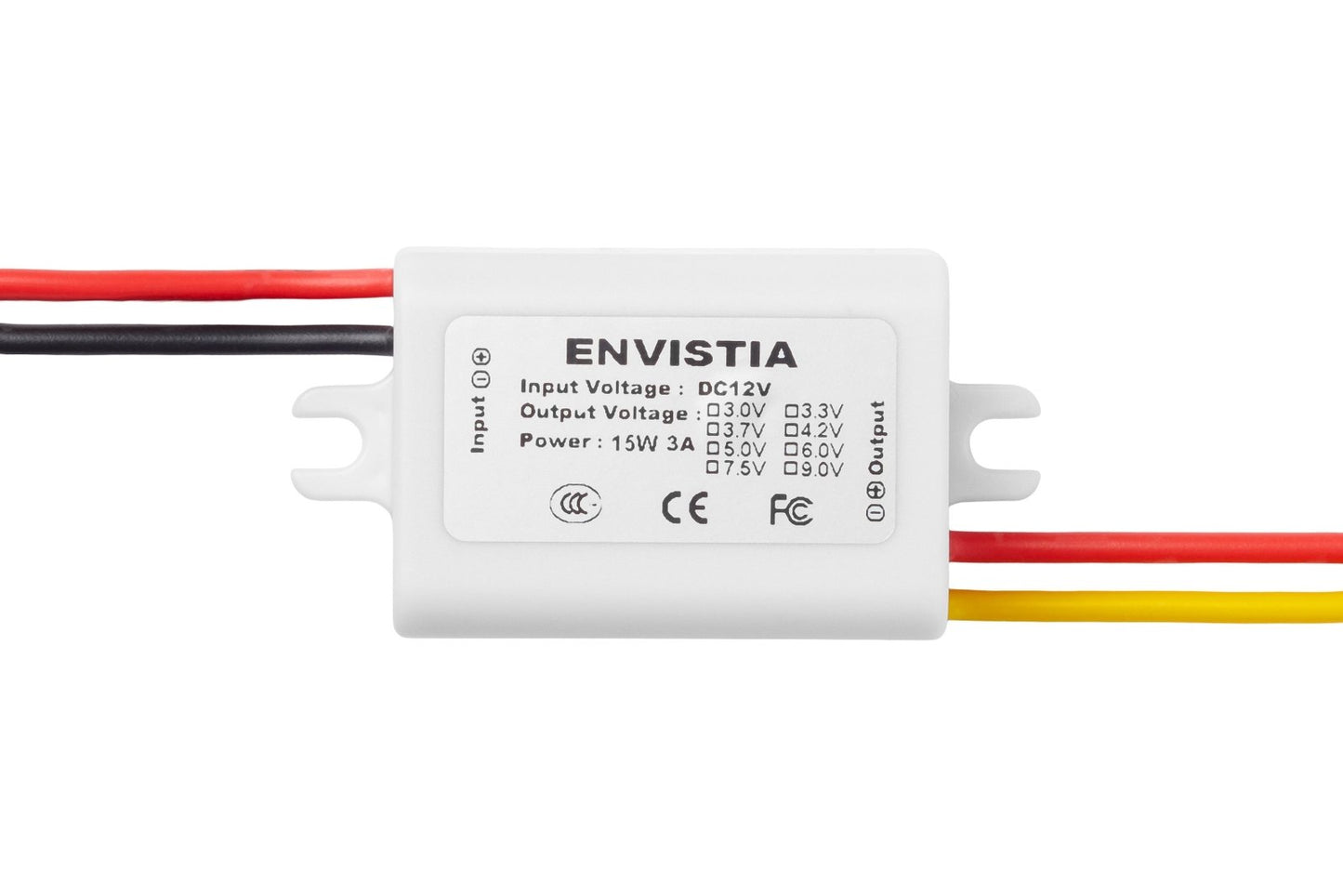
Two pairs of wires — no pins or connectors needed. Simply splice, solder, or crimp into your circuit.
| Wire Color | Function |
|---|---|
| Red (input side) | Input +V — connect to your 12V positive supply |
| Black (input side) | Input Ground — connect to your 12V negative/ground |
| Red (output side) | Output +V — connect to your load's positive terminal |
| Yellow (output side) | Output Ground — connect to your load's negative/ground terminal |
Wire gauge: all leads are 0.5mm² cross-sectional area (20 AWG).
⚠️ Important: Double-check polarity before powering up. Reversing the input wires can damage the converter, and reversing the output wires can damage your connected device.
⚠️ Important Notes
Your 12V input power source must be able to supply at least as much power as your load will draw from the output, divided by the converter's efficiency (~96%). If the input source can't keep up, the output voltage will fold back (sag) rather than deliver the full 3.3V. See the full User Guide linked below for wiring diagrams and a detailed power-budget walkthrough.
📦 What's in the Box
- 1× 12V to 3.3V 3A Mini DC-DC Step-Down Converter (F23J3V3A4S)
🎯 Applications
- Sensor and remote monitoring power — Power 3.3V sensors, dataloggers, or wireless modules from a 12V battery or solar setup
- Microcontroller projects — Cleanly power 3.3V-logic boards from a 12V supply
- Camera and dash accessory power — Step down 12V vehicle or DC power to 3.3V for small electronics
- Retrofit and OEM replacement power — Replace failed linear regulators with an efficient, waterproof drop-in solution
📄 Documentation & Resources
- User Guide — Wiring, specifications, Mechanical & STEP Files, power-budget calculations & troubleshooting
- All Buck Step-Down DC/DC Converter User Guides
🛒 Other Models in the F23JxVxA4S Series
- 12V to 5V 3A DC-DC Converter (F23J5V3A4S)
- 12V to 6V 2.5A DC-DC Converter (F23J6V2.5A4S)
- 12V to 9V 1.7A DC-DC Converter (F23J9V1.7A4S)
Sold and supported by Envistia Mall. Ships from the USA. For wiring diagrams, sample code, Mechanical & STEP files, and troubleshooting, see the User Guide tab on this product page. The manufacturer and Envistia LLC (dba Envistia Mall) are not responsible for any damages or losses resulting from the use of this product. Always follow proper electrical safety practices when working with electronic components. Specifications are based on manufacturer data and are subject to change without notice.
Envistia P/N: F23J3V3A4S
Share

- 5 stars: 17 (85%)
- 4 stars: 2 (10%)
- 3 stars: 1 (5%)
- 2 stars: 0 (0%)
- 1 star: 0 (0%)
I installed this step down in my camper to power my level mate pro that originally took a button cell battery. I’ve had it installed for over a year with no issues!
Used this to step down the power for my Ring Alarm Retrofit Kit. The retrofit panel that connects your existing sensors from a legacy wired alarm system to use Ring Alarm only runs on battery, I quickly found out that the legacy wired motion sensors quickly drained the battery on the retrofit kit and the battery was dead in a little over a month. I purchased this and wired it to the 12v power that is providing power to the old alarm panel and connected the other to the positive side of the battery terminal in the retro fit kit, now I don't have to worry about a separate battery as there is still a 12v backup battery in the old alarm panel in case of a power outage.
Used this to wire in a solar yard light purchased from the "Really" cheep tool store into my barn that is wired to 12 VDC with solar panels, also from the "Really" cheep tool store.No flicker from the ripple of the output that I can see.Don't have an O-Scope to measure for the ripple.12 VDC to 3 VDC the ripple would be minimal at worst.The real test will be how long will this last.Will give it 6 months.If fails in 6 months will update with more information.
This thing worked out great!I got a garage door opener for my motorcycle that was battery operated. It was awesome but the damn battery kept dying. Soldered some wire ends to the battery holder, tied them to this transformer, and wired it to my motorcycles battery. Works great & has been for a few months now
I used this device to convert a solar panel 12 vdc to 3 vdc and remove the batteries. Works well. Amazing what can be found on the internet.
I want to use this to replace a CR2032 battery which is 3.0 Vdc and this unit is outputting more, even thought it says 3.0V on the unit.Thats why I deducted 1 star.
Does what I needed
I've used 5 of these to hardwire garage door openers for motorcycles. Suggest soldering the switch on the opener to always closed, and power to this being triggered, that way it's only running when you need it to be, avoid heat concerns. Also this is mostly empty space, you can easily trim a half-inch in height off it safely if you're going to encapsulate-epoxy it into another project box, which is how I do it, nice slim 2.5x1.5x0.75 inch boxes work great for this whole project plus encapsulation.
Removed existing 12v cigarette plug on 2021 Road Glide and hard wired this converter with a momentary switch to activate my garage door opener.
I wired a garage door opener directly to a customer's 2022 Harley Tri Glide. This brought the voltage from 12 down to 3 which is what the garage door opener required. This was easy to wire in and it works perfectly.
Works well
I was implementing kind of a customized use of a device that was unintended that required 2 AA Batteries. So I installed this and a fuse on a circuit in my car that is only powered when the ignition is on. So Voila ! I no longer need to worry about batteries !!!
Saw a few negative reviews about diagram/instructions...Product is clearly labeled with input +/- and output +/-, not sure what other diagram you would need.I will definitely be buying more of these.
Have levelmate pro installed in my rv. Instead of changing the batteries every couple weeks I wires in this 12v to 3v converter. Works perfectly!
Used these (I bought 2) to step down the voltage from a 20v tool battery to 3v to power a small gasoline pump. Has worked well so far (3 months), don't know about durability.
I used this so I could stop replacing button cell batteries on my travel trailer. This silent and works well for my use case. Some people claim the way this functions can cause "noise" that interferes with signal like Bluetooth but I haven't noticed any negative effects.
I use this buck regulator to drop the 12 Vdc from my trolling motor battery to 3 Vdc for the bubbler in my minnow bucket. Batteries don't last long in a bubbler. Two sets of batteries would pay for it and I will never run out of power for my bubbler and don't have to change batteries every day or so. Wire it in before the switch on the positive side and to the negative side of the motor and the switch will still work and you can still use batteries if 12 Vdc isn't available. I double sided taped it to the face of the bubbler and have a dc power jack for the regulator and a matching dc plug on the wire on a long enough wire with alligator clips to attach to the battery terminals. It is very portable. With batteries I can unplug the wire and use it bank fishing or with the wire and alligator clips I can use it on my (or even my buddy's) boat.
I replaced my RV thermostat with a wifi model, only problem was the new thermostat required 2 AA batteries, and they wouldn't even last a whole month. I got this 3V step down module, using the RV's 12volt power as the source, and bypassed the wifi thermostat batteries. Works perfectly, and now never have to change batteries.
I have a Lacrosse BC900 NIMH charger which requires an AC wall wart. These adaptors are known to be the Achilles heel of the charger because they frequently end up failing. Worse, a replacement is hard to find because they are an old ball adaptor - 3volts at 4A!!When I started searching for another replacement adaptor I decided to try one of these 12 volt to 3 volt DC to DC converters. That way, I could connect it up in a car or run it off my Solar station.Since I only used the Lacrosse at, at most 2A I figured it would work.Does it work? Yes. Would I recommend this for people in general? That depends, read on.The unit itself seems to perhaps be a linear? Converter. If it is, that means it's not going to be the most efficient device for doing this conversion. All the components are covered by what appears to be an Epoxy style resin. This is definitely to make the unit water resistant. However, it also means it's next to impossible to reach any of the components.Why would you want to do that? Well, for starters there is no Cooling inside the box which I can see. AND THIS UNIT GETS HOT AS HECK under a heavier load. It's rated for 3A but there is NO WAY I would try to run 3 amps through this thing. It's HOT at 2A. I don't mean warm are mildly hot, I mean you can not hold your finger to it for 30 seconds HOT.I took it apart and after finding the mega hot chip, I scrapped and sanded away the resin on the top of this chip (30 minutes). I then added some MX CPU paste and a metal Mosfet cooler. Since my big Mosfet sink is crazy hot when this thing is pulling 2A, I assume it is contributing to the cooling. The plastic casing top is still On Fire though.Gee, I wonder why other reviews show melted parts in the resin?Should you get one of these converters? (I mean in general because I bet ALL of them sold in the small plastic boxes regardless of brand are like this). That depends on the load and purpose you are using it for.If you are pulling a small load like 1 Amp or less, it should work without getting hot. If you need a water resistant adaptor it would work.However, if this thing is going to be used indoors and in a fixed position without being moved around a lot, you're better off buying something else. There are better designed adjustable DC-DC converters like the 50 watt DROK for about 2X the price. Those are not water proof and they are not designed to be moved around or tossed around in a vehicle so it's a trade off. They are vastly better designed with a real inductor in the circuit.Summing up, I'll go ahead and use this for as long as it lasts. I hope my Mosfet sink helps but this thing is better used at only 1 amp or less. If you need more than that- you might want to rethink things....
The Ring Retrofit Alarm Kit uses (2) Duracell CR17345 (123) 3v 1.47AH batteries. My old alarm system supplies 12v DC and has a 12v battery backup. This module converts the 12v DC to 3v DC and 3A. So it works perfectly to replace the 2 batteries and save $. I did not leave the batteries installed (to have them charging). The setup has been working great for 6 months so far.