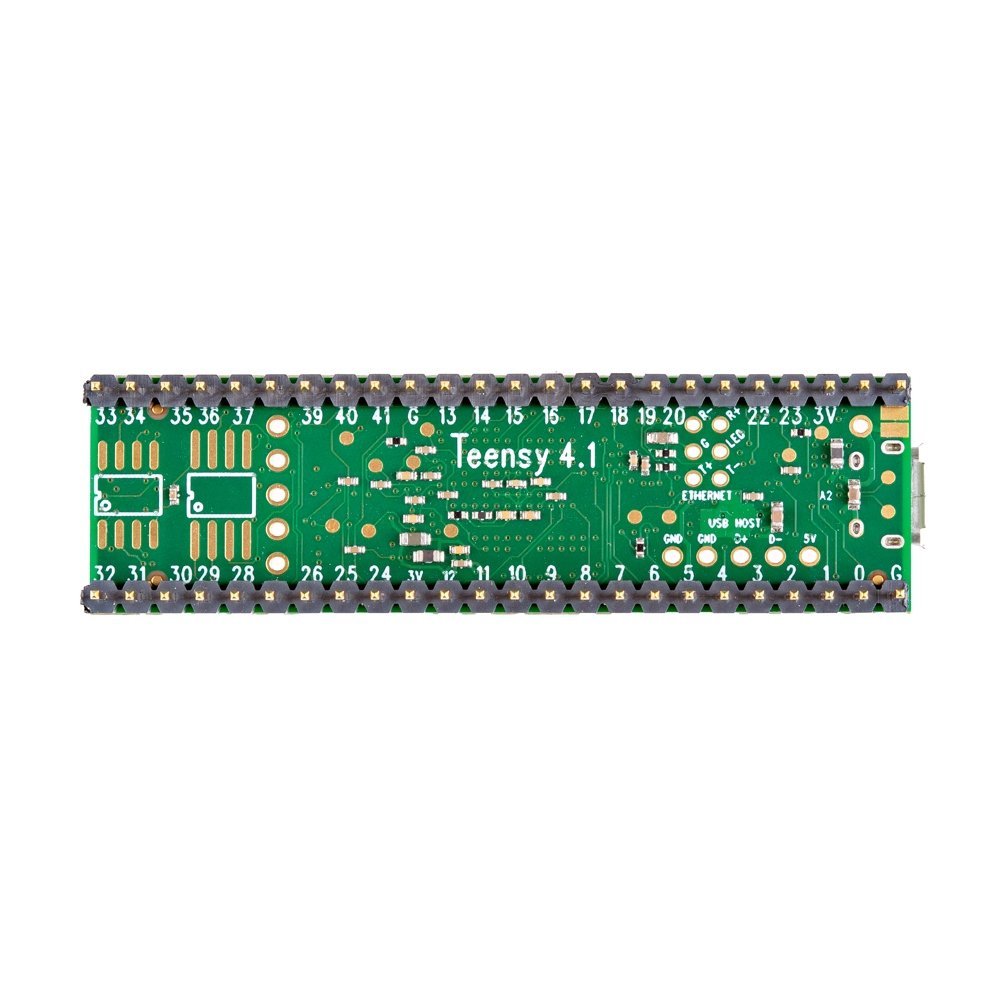


PJRC Teensy 4.1 ARM Cortex-M7 Microcontroller Development Board - w/ & w/o Pins & Lockable
PJRC Teensy 4.1 ARM Cortex-M7 Microcontroller Development Board - w/ & w/o Pins & Lockable
Couldn't load pickup availability
📋 Overview
The Teensy 4.1 is the flagship development board from PJRC, built around a blazing-fast 600 MHz ARM Cortex-M7 processor with 8MB of flash memory and 1MB of RAM. It packs an extraordinary amount of connectivity — built-in Ethernet, a microSD card socket, a USB host port, and 55 I/O pins — into a compact, breadboard-friendly form factor measuring just 2.4 × 0.7 inches.
Whether you're building a high-speed data logger, a multi-channel audio processor, an LED art installation, or a networked IoT device, the Teensy 4.1 delivers the raw performance and I/O density that other microcontroller boards simply can't match — all while remaining fully compatible with the Arduino IDE.
🏪 Why Buy from Envistia Mall?
As an authorized PJRC/SparkFun reseller, our pricing is always competitive with other suppliers — and often better than resellers who mark these boards up at a premium.
- Competitive Pricing — No inflated markups. We price Teensy products competitively with the manufacturer's suggested retail price.
- User Guides & Documentation — Most products we sell include our own plain-English user guides with wiring diagrams and getting-started instructions, so you can get up and running quickly.
- Curated Accessories — We stock the compatible accessories you'll actually need — header pins, PSRAM chips, Ethernet kits, and more — all in one place.
- Responsive Customer Support — We're here to help with orders, shipping, and general product questions.
- Fast US Shipping — We ship from the United States with quick handling times.
- Hassle-Free Returns — Simple, no-hassle return policy if something isn't right.
⭐ Key Features & Benefits
- 600 MHz ARM Cortex-M7 Processor — One of the fastest microcontrollers available. The dual-issue superscalar architecture can execute two instructions per clock cycle, delivering performance many times faster than typical 32-bit microcontrollers.
- 8MB Flash + 1MB RAM — Four times the flash memory of the Teensy 4.0, with 512K of tightly coupled RAM for single-cycle access. Room for large programs, embedded fonts, audio clips, and complex data structures.
- Built-in 10/100 Mbit Ethernet — Includes an onboard DP83825 Ethernet PHY chip (ethernet connector kit sold separately). Connect your project directly to a wired network without additional shields.
- MicroSD Card Socket — Built-in SD card slot using fast 4-bit native SDIO for high-speed data logging, file storage, and media playback.
- USB Host Port — Connect USB keyboards, mice, MIDI controllers, joysticks, and other USB devices directly to the Teensy 4.1 while simultaneously communicating with your computer via the main USB port.
- 55 Digital I/O Pins (42 Breadboard-Friendly) — Massive I/O capability including 35 PWM outputs, 18 analog inputs, 8 serial ports, 3 SPI, 3 I2C, and 3 CAN Bus ports.
- Hardware Floating Point Unit (32 & 64-bit) — Full hardware acceleration for both single and double precision math. Functions like sin(), cos(), and log() execute at hardware speed — not through slow software emulation.
- Expandable Memory — Two locations on the bottom of the board accept optional QSPI memory chips, allowing you to add up to 16MB of PSRAM or additional flash storage.
- Arduino IDE Compatible — Program with the familiar Arduino IDE using the Teensyduino add-on. Also supports PlatformIO, Visual Micro, CircuitPython, and command-line toolchains.
- Real-Time Clock (RTC) — Built-in RTC with dedicated 32.768 kHz crystal. Add a CR2032 coin cell to maintain date/time while powered off.
- Overclockable to 912 MHz — For projects that need even more speed, the Teensy 4.1 can be overclocked well beyond its rated 600 MHz.
🎯 Ideal Applications
- Multi-channel audio processing and synthesis (with the Teensy Audio Library and Audio Shield)
- Large-scale addressable LED installations (WS2812B/NeoPixel via OctoWS2811)
- High-speed data logging to SD card
- Networked IoT devices and Ethernet-connected controllers
- CAN Bus automotive and industrial control projects
- USB HID devices — custom keyboards, MIDI controllers, joysticks, flight sim panels
- Real-time signal processing and DSP
- Robotics and motor control (35 PWM channels)
- DMX lighting control
- Commercial and secure embedded products (Lockable variant available)
📊 Specifications
| Parameter | Value |
|---|---|
| Processor | NXP IMXRT1062 (ARM Cortex-M7) |
| Clock Speed | 600 MHz (overclockable to 912 MHz) |
| Floating Point Unit | Hardware 32-bit & 64-bit |
| Flash Memory | 8 MB (7936K usable for programs) |
| RAM | 1024K (512K tightly coupled) |
| EEPROM | 4284 bytes (emulated) |
| Digital I/O Pins | 55 total (42 breadboard-friendly) |
| PWM Outputs | 35 |
| Analog Inputs | 18 |
| Serial Ports | 8 (all with FIFOs) |
| SPI Ports | 3 |
| I2C Ports | 3 |
| CAN Bus | 3 (1 with CAN-FD) |
| USB | Device (480 Mbit/s) + Host (480 Mbit/s) |
| Ethernet | 10/100 Mbit with DP83825 PHY |
| SD Card | MicroSD socket (4-bit SDIO) |
| Digital Audio | 2× I2S/TDM + 1× S/PDIF |
| DMA Channels | 32 |
| Operating Voltage | 3.3V (onboard regulator from 5V USB/VIN) |
| Input Voltage | 3.3V logic (not 5V tolerant) |
| Power Consumption | ~100 mA at 600 MHz |
| Board Dimensions | Approx. 61 × 18 mm (2.4 × 0.7 inches) L × W |
| Regulatory | FCC, ISED, CE, UKCA, RoHS, REACH compliant |
Pinouts
Teensy 4.1 is designed to bring all general purpose I/O pins to breadboard friendly pads on the outside edges.

Note: The Teensy 4.1 version WITHOUT PINS does not include headers and, if needed in your application, will need to be purchased separately and soldered on yourself. The version WITH PINS includes pins soldered to the board.
📦 What's in the Box
- 1× Teensy 4.1 Development Board (with or without soldered pins, depending on variant selected)
- 1× Pinout Reference Card
Note: Ethernet connector kit and PSRAM chips are sold separately.
🔧 Available Variants
| SKU | Variant | Best For |
|---|---|---|
| TEENSY41 | Standard, with no pins | Prototyping, experimentation, learning |
| TEENSY41_SP | Standard, with pins soldered to the board | Prototyping, experimentation, learning |
| TEENSY41_LOCK | Lockable, with no pins | Commercial products, secure applications |
The Lockable variant supports PJRC's Code Security features, including encrypted firmware updates, program memory protection, and JTAG disable — ideal for commercial products where intellectual property protection is critical.
💻 Software Compatibility
- Arduino IDE — Primary development environment with the Teensyduino boards add-on (installed via Boards Manager). Includes a large collection of optimized libraries.
- PlatformIO — Cross-platform IDE with advanced features. Supports Windows, Mac, and Linux.
- Visual Micro — Use Microsoft Visual Studio to program Teensy (Windows only, commercial software).
- CircuitPython — Python-based programming (partial hardware support).
- Command Line / Makefile — For non-graphical development workflows.
⚠️ Important Notes
- 3.3V Logic Only — All digital and analog pins operate at 3.3V. The pins are not 5V tolerant. Do not apply more than 3.3V to any pin.
- Ethernet Connector Sold Separately — The Ethernet PHY chip is onboard (standard variant), but you'll need the RJ45 MagJack Ethernet Kit to connect a cable.
- Header Pins Not Soldered — The board ships without header pins. Solder your own or purchase pre-soldered variants if available.
- USB Cable Required — A USB Micro-B cable is needed for programming and power (not included).
📄 Documentation & Resources
- User Guide: Envistia's Teensy 4.1 User Guide
- PJRC Official Product Page: Teensy 4.1 — Full Specifications & Technical Details
- PJRC Teensy Model Comparison: Compare All Teensy Models
- Teensyduino Software: Download Arduino IDE + Teensy Boards Add-on
- Processor Reference Manual: NXP IMXRT1060 Reference Manual (with PJRC annotations)
- All Teensy Products: Browse Teensy Boards & Accessories at Envistia Mall
Sold and supported by Envistia Mall. Ships from the USA. For wiring diagrams, sample code, and troubleshooting, see the User Guide. The manufacturer and Envistia LLC (dba Envistia Mall) are not responsible for any damages or losses resulting from the use of this product. Always follow proper electrical safety practices when working with electronic components. Specifications are based on manufacturer data and are subject to change without notice.