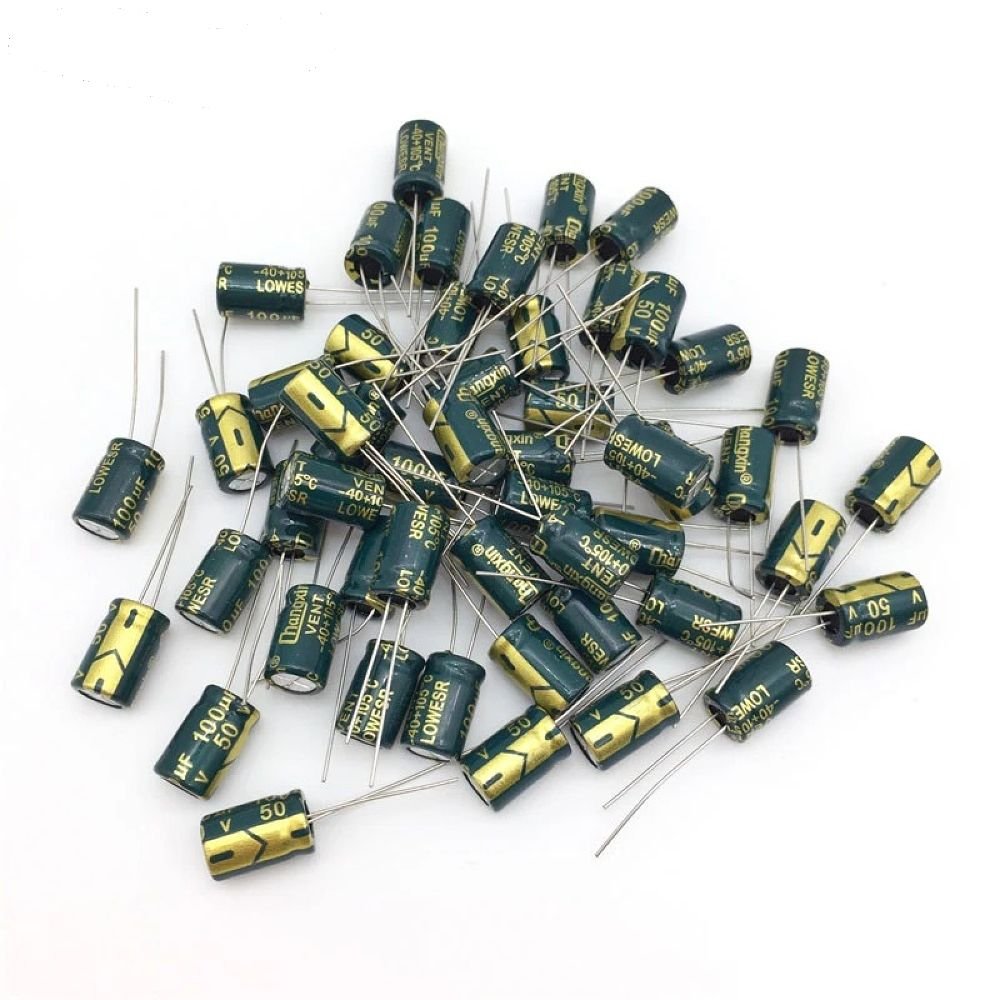


100µF 50V Low ESR Electrolytic Capacitor — 105°C, Radial, High Frequency — 5/10/25 Pack
100µF 50V Low ESR Electrolytic Capacitor — 105°C, Radial, High Frequency — 5/10/25 Pack
No se pudo cargar la disponibilidad de retiro
Keep your circuits clean and your power rails stable with these 100µF 50V Low ESR Electrolytic Capacitors. Rated for 105°C operation and designed for high-frequency, low-impedance applications, they're a direct upgrade over standard 85°C capacitors — lasting longer, handling more ripple current, and performing better in demanding environments like switch-mode power supplies, LCD monitor boards, and audio amplifiers.
Whether you're repairing a blown capacitor on a motherboard, filtering a noisy power rail on an Arduino project, or building an audio crossover, these are the capacitors to reach for. Sold in multi-packs because you always need more than one.
⚡ Key Features
- Low ESR (Equivalent Series Resistance): Designed for high-frequency switching circuits where standard capacitors can't keep up. Lower ESR means better filtering, less heat, and longer life.
- 105°C temperature rating: Rated for continuous operation at 105°C — significantly more durable than standard 85°C capacitors. Higher temperature rating = longer lifespan at any given operating temperature.
- 50V voltage rating: Handles circuits up to 50V DC with margin. Suitable for 5V, 12V, 24V, and 36V applications.
- Radial lead type: Standard through-hole radial leads with 3.5mm spacing — fits standard PCB footprints and breadboards.
- Compact size: 8mm diameter × 12.5mm height — fits in tight PCB layouts and project enclosures.
- Multi-pack value: Available in 5-pack, 10-pack, and 25-pack quantities.
🎯 Perfect For
- LCD monitor & TV repair — replace bulging or leaking capacitors on power supply and inverter boards. Failed electrolytic capacitors are the #1 cause of dead or flickering LCD monitors.
- Computer motherboard repair — replace failed capacitors near the CPU VRM (voltage regulator module) that cause instability, random reboots, or failure to POST.
- Power supply repair & builds — output filtering for switch-mode power supplies (SMPS), linear regulators, and bench power supplies.
- Arduino & microcontroller projects — power rail decoupling, motor driver filtering, and sensor noise reduction. Essential for stabilizing PIR sensors (HC-SR501), stepper motor drivers (A4988), and servo power rails.
- Audio electronics — power supply filtering for amplifiers, crossover networks, and DAC boards. Low ESR reduces hum and improves audio clarity.
- LED driver circuits — output smoothing for PWM-driven LED power supplies.
- Automotive electronics — filtering and decoupling in 12V and 24V vehicle electrical systems.
- General electronics repair & prototyping — a must-have value in every parts bin.
🔧 What Is ESR and Why Does It Matter?
ESR (Equivalent Series Resistance) is the internal resistance of a capacitor. All capacitors have some ESR, but lower is better — especially in power supply filtering and high-frequency circuits.
- High ESR capacitors (standard grade) generate more internal heat, filter less effectively, and fail sooner in demanding applications.
- Low ESR capacitors (like these) handle higher ripple currents, filter more effectively, run cooler, and last significantly longer.
If you're replacing a failed capacitor on a motherboard or power supply, always replace with a low ESR capacitor — it's likely that the original failed precisely because it was a standard-ESR part that couldn't handle the ripple current.
📐 Specifications
- Capacitance: 100µF
- Capacitance tolerance: ±20%
- Voltage rating: 50V DC
- Temperature rating: 105°C
- ESR: Low ESR (high-frequency grade)
- Type: Aluminum electrolytic
- Lead type: Radial (through-hole)
- Lead spacing: 3.5mm (0.14")
- Body diameter: 8mm (0.32")
- Body height: 12.5mm (0.50")
- Polarized: Yes — observe polarity markings (negative stripe on case, longer lead = positive)
📦 Package Contents
- 5, 10, or 25 × 100µF 50V Low ESR Electrolytic Capacitors (select quantity above)
💡 Polarity Reminder: Electrolytic capacitors are polarized — they must be installed in the correct orientation. The negative (−) lead is marked by a stripe on the case and has a shorter lead. The positive (+) lead is longer. Reversing polarity can cause the capacitor to fail, overheat, or rupture. Always double-check before soldering or powering on.
Share