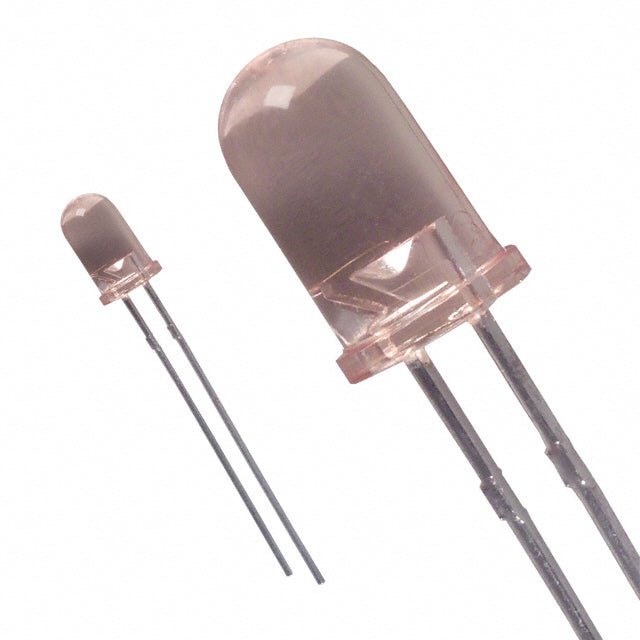


QED123 Infrared (IR) LED Emitter 880nm 5mm – Narrow Beam, High Power – onsemi
QED123 Infrared (IR) LED Emitter 880nm 5mm – Narrow Beam, High Power – onsemi
No se pudo cargar la disponibilidad de retiro
🧭 Product Description
The QED123 is a high-output infrared LED emitter manufactured by onsemi (formerly ON Semiconductor). Built with AlGaAs (Aluminum Gallium Arsenide) chip technology and encapsulated in a clear peach-tinted T-1 3/4 (5mm) package, it emits powerful infrared light at a peak wavelength of 880nm — invisible to the human eye but easily detected by silicon phototransistors and photodiodes.
With a narrow 16° emission angle and 70 mW/sr typical radiant intensity at 100 mA, the QED123 delivers a tightly focused, high-power IR beam ideal for long-range detection, optical communication, and precision sensing applications.
The QED123 is specifically designed to pair with the QSD123 and QSD124 phototransistors (sold separately), forming a matched emitter/detector pair optimized for maximum coupling efficiency at 880nm.
✅ Key Features
- Peak Emission Wavelength: 880nm (near-infrared, invisible to the human eye)
- High Radiant Intensity: 70 mW/sr typical at 100 mA — strong, focused IR output
- Narrow Emission Angle: 16° for precise, directional beam control
- Fast Switching: 900 ns rise time, 800 ns fall time — suitable for modulated/pulsed IR applications
- AlGaAs Chip Technology: Superior efficiency and output power compared to standard GaAs IR LEDs
- Wide Operating Range: -40°C to +100°C
- Standard T-1 3/4 (5mm) Package: Easy breadboard and through-hole PCB mounting
- Matched Detectors: Designed to pair with QSD123/QSD124 phototransistors
- Continuous Forward Current: Up to 100 mA
- Pb-Free / RoHS Compliant
- Manufacturer: onsemi (formerly ON Semiconductor)
📊 Specifications
| Parameter | Symbol | Value | Unit |
|---|---|---|---|
|
Peak Emission Wavelength
|
λPE
|
890 (typ)
|
nm
|
|
Wavelength Temp. Coefficient
|
TCλ
|
0.2
|
nm/°C
|
|
Emission Angle
|
2Θ½
|
16
|
°
|
|
Radiant Intensity (typ)
|
IE
|
70 (typ), 50 (min)
|
mW/sr
|
|
Radiant Intensity Temp. Coefficient
|
TCIE
|
-0.3
|
%/°C
|
|
Forward Voltage (max)
|
VF
|
1.7
|
V
|
|
Forward Voltage Temp. Coefficient
|
TCVF
|
-6
|
mV/°C
|
|
Continuous Forward Current (max)
|
IF
|
100
|
mA
|
|
Reverse Voltage (max)
|
VR
|
5
|
V
|
|
Reverse Current (max)
|
IR
|
10
|
µA
|
|
Rise Time (typ)
|
tr
|
900
|
ns
|
|
Fall Time (typ)
|
tf
|
800
|
ns
|
|
Junction Capacitance (typ)
|
Cj
|
11
|
pF
|
|
Power Dissipation
|
PD
|
200
|
mW
|
|
Operating Temperature
|
TOPR
|
-40 to +100
|
°C
|
|
Storage Temperature
|
TSTG
|
-40 to +100
|
°C
|
|
Package
|
—
|
T-1 3/4, 5mm (Case 100CC)
|
—
|
|
Package Material
|
—
|
Clear, Peach Tinted Plastic
|
—
|
|
Chip Material
|
—
|
AlGaAs
|
—
|
Test conditions: IF = 100 mA, tp = 20 ms, TA = 25°C unless otherwise noted.
Power dissipation derated linearly at 2.67 mW/°C above 25°C.
🔌 Pin Identification
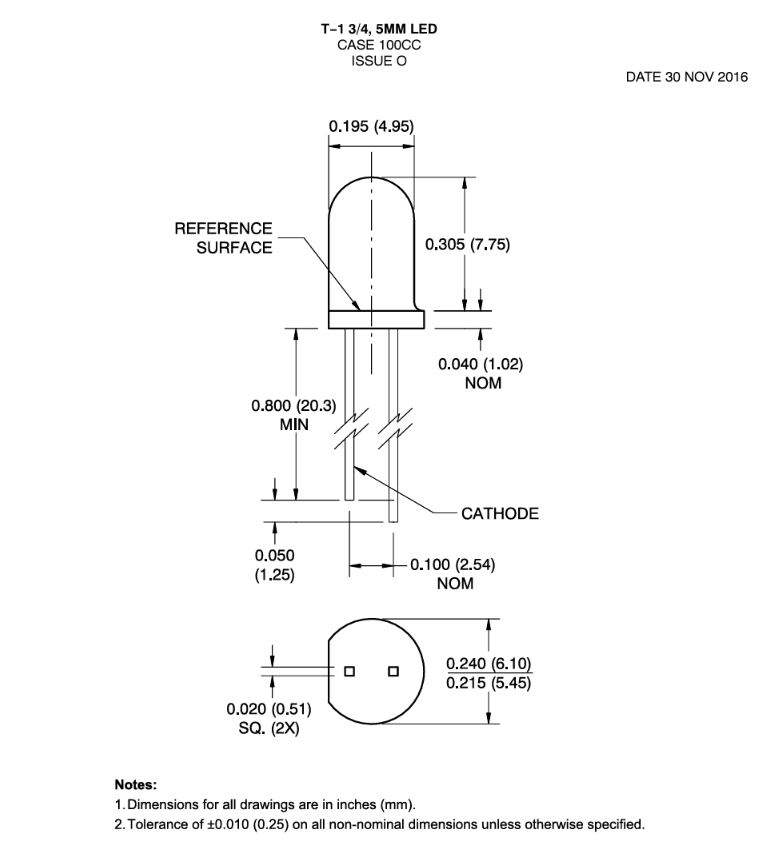
The QED123 is a 2-lead device in a standard T-1 3/4 (5mm) radial package:
| Pin | Function |
|---|---|
|
Longer Lead
|
Anode (+)
|
|
Shorter Lead
|
Cathode (−)
|
|
Flat on Package Base
|
Indicates Cathode side
|
Note: Like all LEDs, the QED123 is a polarized component. The flat edge on the base of the package identifies the cathode (−) lead. Reversing polarity will prevent the LED from emitting and may cause damage if reverse voltage exceeds 5V.
🔧 Typical Circuit Connection
Basic IR Emitter Circuit
Connect the QED123 in series with a current-limiting resistor to your DC supply:
VCC ──── R (current limiting) ──── QED123 Anode (+) ──── QED123 Cathode (−) ──── GND
Choosing a Current-Limiting Resistor
Use Ohm's Law: R = (VCC − VF) / IF
| Supply Voltage | Target Current | Resistor Value | Radiant Intensity |
|---|---|---|---|
|
3.3V
|
20 mA
|
82 Ω
|
~20 mW/sr (reduced output)
|
|
5V
|
50 mA
|
68 Ω
|
~45 mW/sr
|
|
5V
|
100 mA
|
33 Ω
|
~70 mW/sr (maximum output)
|
|
12V
|
100 mA
|
100 Ω
|
~70 mW/sr (maximum output)
|
Note: VF is approximately 1.7V at 100 mA. For maximum IR output and detection range, drive at 100 mA. For battery-powered or low-power applications, 20 mA provides adequate output at shorter ranges.
Driving from a Microcontroller (Arduino, ESP32, etc.)
Most microcontroller GPIO pins can only source 20–40 mA. To drive the QED123 at full 100 mA output, use an NPN transistor or N-channel MOSFET as a switch:
GPIO Pin ──── R1 (1kΩ) ──── NPN Base
NPN Collector ──── QED123 Cathode (−)
NPN Emitter ──── GNDVCC ──── R2 (33Ω) ──── QED123 Anode (+) ──── NPN Collector
When the GPIO pin goes HIGH, the transistor turns on and drives the QED123 at full current.
🔄 Matched Emitter/Detector Pair
The QED123 is specifically designed to work with onsemi's QSD12X phototransistor family:
| Emitter | Detector | Pairing Notes |
|---|---|---|
|
QED123 (this product)
|
QSD123
|
Standard sensitivity detector
|
|
QED123 (this product)
|
QSD124
|
High sensitivity detector (recommended for longer range)
|
Why use a matched pair?
- The QED123 emits at 880nm — the exact peak sensitivity wavelength of the QSD123/QSD124
- Matched spectral characteristics maximize coupling efficiency and detection range
- The QSD123/QSD124's built-in daylight filter blocks visible light while passing the QED123's 880nm emission, reducing false triggers
The QSD124 phototransistor is available in our store. Using the QED123 + QSD124 pair gives you the longest detection range and highest sensitivity combination in the QSD12X/QED12X family.
🛠️ Common Applications
- Object / Presence Detection — Transmit an IR beam to a QSD124 detector; detect when objects break the beam
- Optical Counters — Count items on a conveyor or production line
- Proximity Sensors — Detect nearby objects via reflected IR
- Optical Encoders — Rotary and linear position sensing
- Optical Switches / Interrupters — Slotted optical switch applications
- IR Remote Control Transmitters — Send IR commands to receivers
- Line-Following Robots — Illuminate surfaces for IR reflectance sensing
- Wireless IR Communication — Short-range data transmission via modulated IR
- Tachometers / RPM Counters — Provide the IR source for reflected/interrupted beam sensing
- Security Systems — IR beam break detection for perimeter monitoring
💡 Design Tips
- Pulsed operation allows higher peak currents and extends detection range without exceeding average power limits. The QED123's fast 900 ns rise time makes it well-suited for pulsed/modulated applications.
- Modulated IR (e.g., 38 kHz carrier) improves noise immunity in environments with ambient IR interference (sunlight, incandescent lighting).
- Alignment matters. With a narrow 16° emission angle, precise alignment between the QED123 emitter and QSD123/QSD124 detector is important for reliable detection, especially at longer distances.
- Temperature affects output. Radiant intensity decreases by approximately 0.3%/°C. At 85°C, output is roughly 82% of the 25°C value. Account for this in designs operating in high-temperature environments.
- Forward voltage decreases with temperature at -6 mV/°C. In temperature-variable environments, consider a constant-current driver rather than a simple resistor to maintain consistent output.
⚠️ Important Notes
- Polarity matters. The QED123 is a diode — it only conducts in one direction. Reversing polarity will prevent emission. Do not exceed 5V reverse voltage.
- Always use a current-limiting resistor. Connecting the QED123 directly to a voltage source without a resistor will destroy it.
- Do not exceed 100 mA continuous forward current or 200 mW power dissipation (derate at 2.67 mW/°C above 25°C).
- IR light is invisible. You cannot see the QED123's output with the naked eye. Use a smartphone camera (most can detect near-IR) to verify the LED is emitting, or use a phototransistor/photodiode circuit.
- Soldering: Use RMA flux. Keep soldering iron tip at least 1.6mm (1/16") from the housing. Iron soldering: 240°C max for 5 seconds. Flow soldering: 260°C max for 10 seconds.
- Not for life-support or medical implant applications per onsemi guidelines.
📦 What's in the Box
- 1, 2, 5, OR 10x QED123 Infrared LED Emitters (onsemi) - quantity selected above
Matched detector: The QSD124 IR phototransistor is the recommended paired detector for this emitter. [Check our store for availability.]
📘 Resources
- Datasheet: QED123/D (Rev. 2, August 2023)
- Matched Detectors: QSD123, QSD124
Share