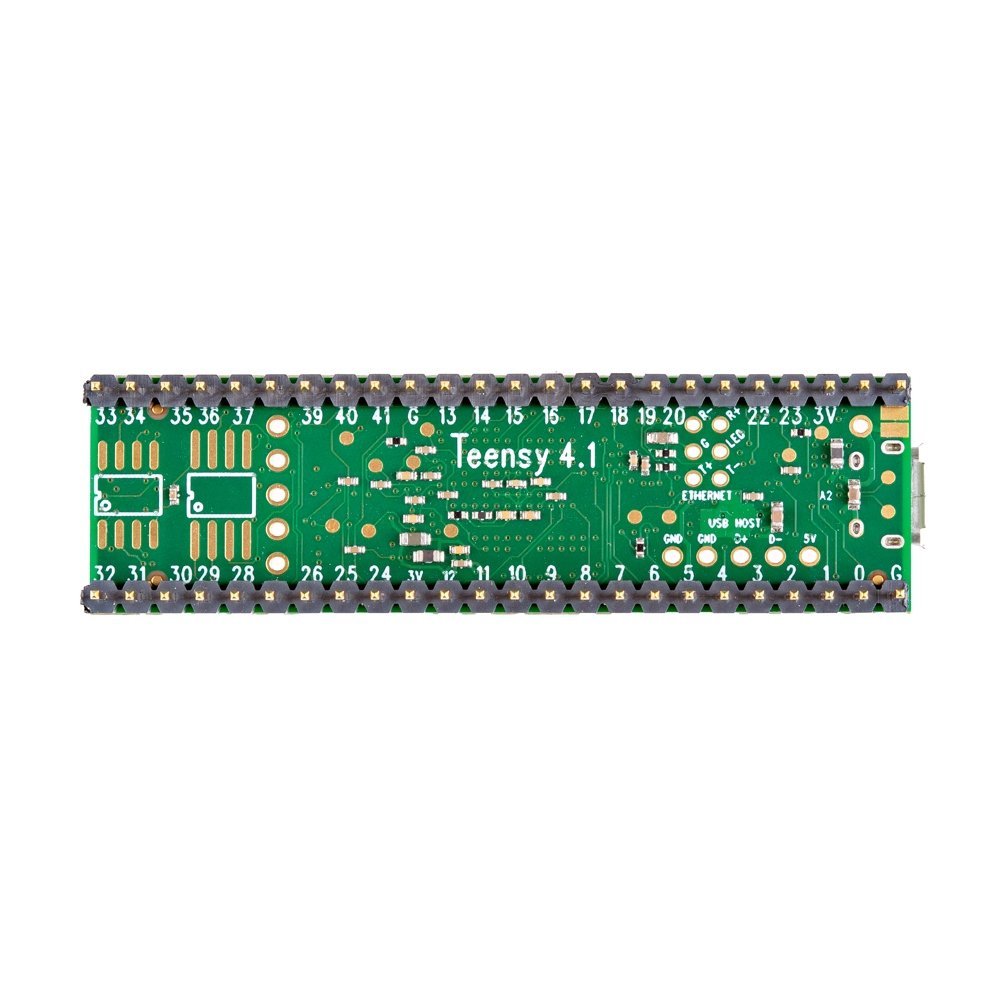
Placa de desarrollo de microcontrolador PJRC Teensy 4.1 ARM Cortex-M7
No se pudo cargar la disponibilidad de retiro
Teensy 4.1 es la última placa de desarrollo de microcontrolador Teensy de PJRC. Cuenta con un procesador ARM Cortex-M7 IMXRT1062 a 600 MHz. El tamaño real es de 2,4 por 0,7 pulgadas, el mismo factor de forma que Teensy 3.6.
Teensy 4.1 utiliza el mismo procesador que Teensy 4.0, pero proporciona una mayor capacidad de E/S, incluido un PHY de ethernet, un zócalo de tarjeta SD y un puerto host USB. Teensy 4.1 también viene con una memoria flash 4 veces más grande y tiene 2 ubicaciones para agregar más memoria opcionalmente.
Especificaciones técnicas en comparación con Teensy 4.0
Teensy 4.1 y 4.0 usan el mismo IMXRT1062, por lo que la mayoría de las especificaciones técnicas son las mismas.
Consulte la página de Teensy 4.0 para conocer las especificaciones y características comunes.
| Característica | Teensy 4.1 | Teensy 4.0 |
|---|---|---|
| Ethernet | 10/100 Mbit DP83825 PHY (6 pines) |
-ninguno- |
| Alojamiento USB | 5 pines con administración de energía |
2 almohadillas SMT |
| SDIO (datos de 4 bits) | Zócalo Micro SD | 8 almohadillas SMT |
| Pines PWM | 35 | 31 |
| Entradas analógicas | 18 | 14 |
| Puertos Serie | 8 | 7 |
| Memoria Flash | 8 MB | 2 MB |
| Memoria QSPI | 2 chips Más memoria de programa |
Solo memoria de programa |
| E/S compatible con placa de prueba | 42 | 24 |
| Señales de almohadilla SMT inferior | 7 | 16 |
| Señales de tarjeta SD | 6 | 0 |
| Total de pines de E/S | 55 | 40 |
Distribución de pines
Teensy 4.1 está diseñado para llevar todos los pines de E/S de uso general a almohadillas compatibles con placas de prueba en los bordes exteriores.

Nota: El Teensy 4.1 no incluye encabezados y, si su aplicación lo necesita, deberá comprarlo por separado y soldarlo usted mismo.< /p>
Recursos:
Foro de PJRC para usuarios de Teensy
Página del producto Teensy 4.1 de PJRC
Share

- 5 stars: 20 (91%)
- 4 stars: 0 (0%)
- 3 stars: 2 (9%)
- 2 stars: 0 (0%)
- 1 star: 0 (0%)
I use these to power first generation RTO flash carts for the Intellivision. So far all three have worked as expected.
Original board, still using it, no issues.
Incredible features and speed in such a small package. Amazing value!
Excellent microprocessor. Way faster than Arduino and more features, with plenty of example code to use for your project.
It got the job done. Not much I can say about it aside from that.
The T4.1 is like an Arduino on steroids, yet still compatible with the IDE, plus PlatformIO.I've spent the past 6 years using the T4.1 to develop a midi controllable laser synthesizer to project abstract imagery from industry standard RGB laser projectors.PJRC's Audio Library and online object oriented Audio Design Tool is a game changer, especially for beginner programmers
It works great.
I've broken a bunch of these, but I'm generally hard on hardware. When they work, they give good service.
Both products together make experimentation in audio processing a great experience.
Works perfectly for me! Although it was a little more expensive than buying from other places, it worked perfectly!
For a little more money you can get the one with extra ram and internet, I don’t know why you’d want this bare bones package. Unfortunately I bought this one and now need to get the networking pack to upgrade it to its full potential. Live and learn I suppose.Also don’t buy this thinking you’re going to make a 32+ button switch box or joystick, unless you can write the code from scratch and can somehow get windows to behave. There is example code in arduino for a 32 button joystick or switch box, but once you try to exceed that number things don’t work correctly (for me anyway).
Teensies are fantastic boards for projects that need a high clock speed unfortunately to make a Teensy an Xbox 360 controller third party libraries will be needed as the default framework hardcodes preselected USB description headers for specific devices. I needed a way to switch from one USB descriptor to another when sending a disconnect command out and I still haven't been able to use this device for that purpose however less dynamic USB connections work fine.
Works well with tons of memory left.
Woks well, definitely worth the money.
This small microcontroller has tremendous power to execute code. It runs at 600 MHz and has an instruction set that is hyper fast! If you feel the need for speed this is your MCU!
Perfect for Synth and MIDI projects. Amazing upgrade from Arduino microcontrollers. I would be nice if it was a 5 volt device, instead of 3.3. but so far it hasn't been a problem for me. Great product!
Duino's and pis and teensies, oh my! This was purchased for an HF project, and works as well as expected!
I used it to convert a kinesis advantage 2 keyboard to use qmk software. Loving it. Flashing is many times faster compared to pro micro/elite c controllers.
I may use this for an audio instant replay. I added 2 psram chips with no problems.
The Teensy itself is great, but in my case VIN and VUSB were not shorted as indicated in the packaged card in photo. Had to manually solder a jumper. Kind of a minor detail and easy to remedy but made me spend a lot of time trying different driver version, USB cables, etc before finally looking at the board and noting that the connection was in fact not shorted. Did not appear to cut by anyone else and my packaging was fresh.After all the fidgeting, my micro USB receptical is now likely damaged.
Good
if you are familiar with the Arduino concept and can program a bit this device is a must... set up a jig to hold you headers and solder them yourself... the teensy 3.5, 3.6, 4.0, 4.1.. wow Wow WOw WOW..... there is no other description for what these devices can do.....the 4.1 using simple digitalWrite HIGH low one can generate 30 nsec pules on that pin, and it can by coding be made faster... writing code to control the logic lines of interfaced chips is possible, SPI and I2C channels also exist not to mention the A/D capabilities..you will need to download the extension to the Arduino IDE and learn the new form of the A/D convert call...in the picture the teensy 3.6 and 4.1 are in setups. the scope picture shows the adj resistance X9C104 being changed it is is series with a 10k to Vcc.. i think it was 10k.... the time expanded pic show the timing detail.. i have delayMicrosecond(10 in the pulse generation code...learn to code.....!